German Phrases for Everyday Travel and Survival
If you’re heading to a German-speaking country, a small set of phrases can make a big difference. You do not need to sound fluent to be understood. You just need a few reliable lines for greetings, asking for help, ordering, and getting around with confidence.
Start with the phrases you will use most
The goal of a survival phrase pack is not to memorize a whole textbook. It is to give you the words you are most likely to need in real life, especially when you are tired, lost, or trying to move quickly through a conversation.
A good rule: learn one phrase for each common situation, then practice it out loud a few times. Even a simple attempt in German usually helps the conversation go more smoothly.
Greetings and polite basics
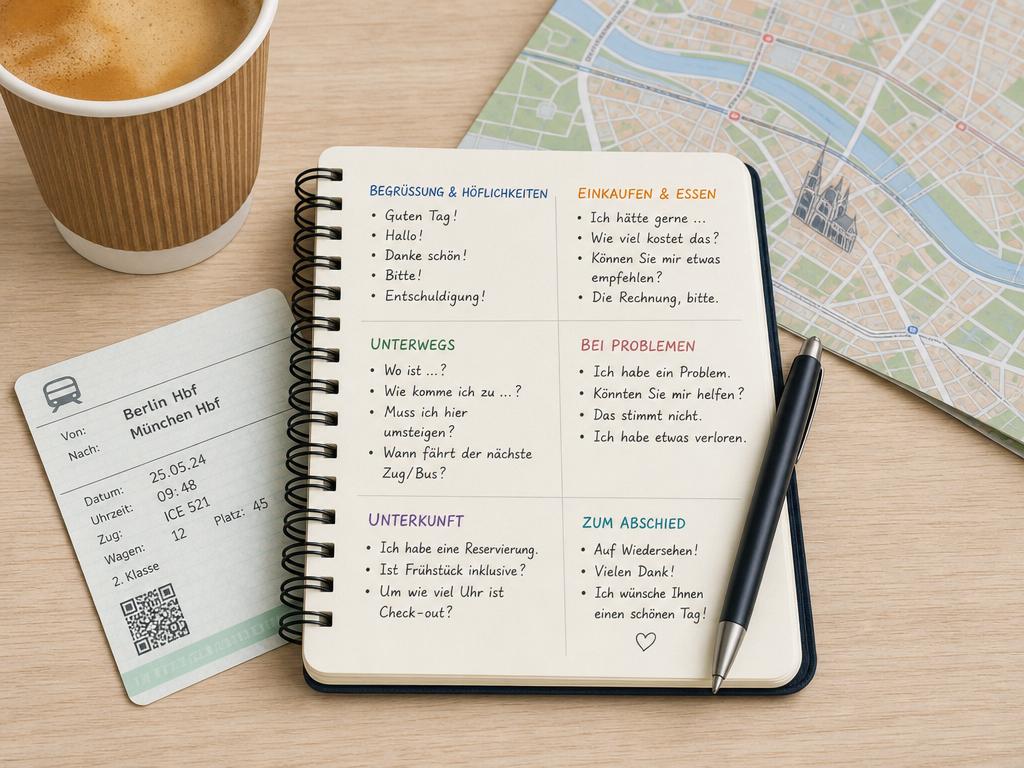
These are the first phrases to know. They are useful in shops, hotels, cafes, train stations, and whenever you want to sound polite without overthinking it.
- Hallo — Hello.
- Guten Morgen — Good morning.
- Guten Tag — Good day / Hello.
- Auf Wiedersehen — Goodbye.
- Bitte — Please / You’re welcome.
- Danke — Thank you.
- Entschuldigung — Excuse me / Sorry.
- Sprechen Sie Englisch? — Do you speak English?
A small practical note: in formal situations, German often uses polite forms. If you are speaking to staff, strangers, or older people, polite phrasing is a safe default. Even a short phrase with Bitte and Danke goes a long way.
Useful phrases for asking directions
When you are in a new city, the most important thing is being able to ask where something is and understand the answer well enough to keep moving.
- Wo ist …? — Where is …?
- Wie komme ich zum Bahnhof? — How do I get to the train station?
- Ist es weit? — Is it far?
- Links — Left.
- Rechts — Right.
- Geradeaus — Straight ahead.
- Hier — Here.
- Dort — There.
If you want a very usable travel sentence, try: Wo ist die U-Bahn? This works well when you need public transport quickly. You can swap in other places too, such as museum, hotel, restroom, or pharmacy.
Ordering food and drinks
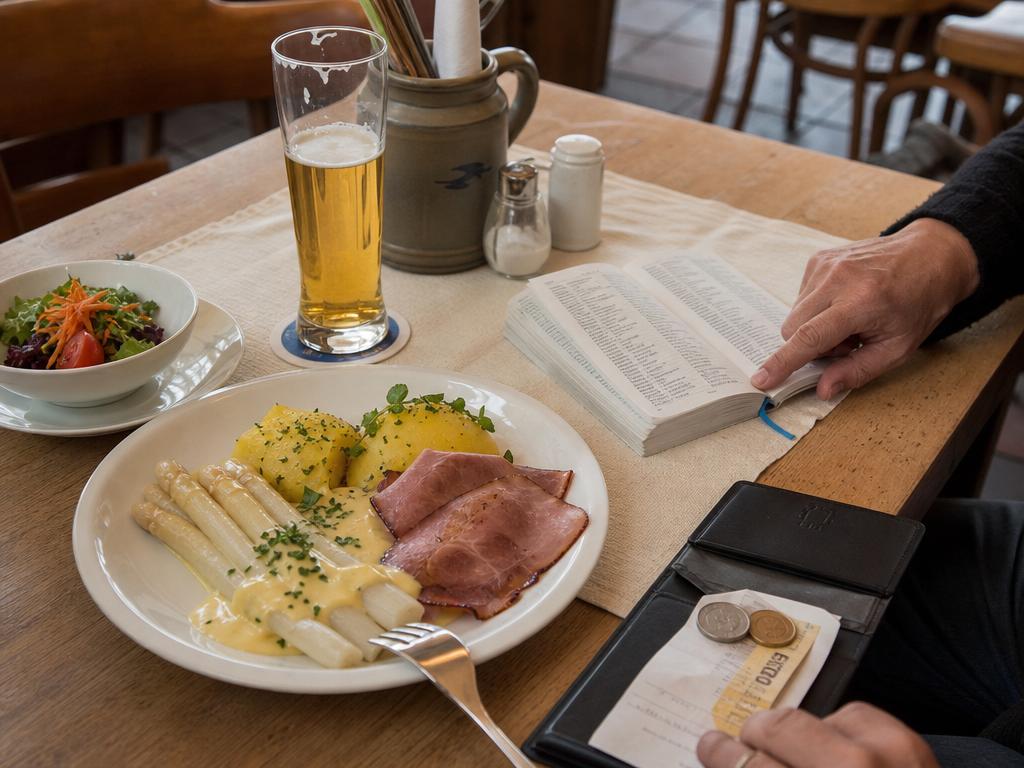
You do not need a huge restaurant vocabulary to order comfortably. A few phrases help you ask for a table, place an order, and handle basic questions from staff.
- Ein Tisch für zwei, bitte. — A table for two, please.
- Ich hätte gerne … — I would like …
- Was empfehlen Sie? — What do you recommend?
- Die Speisekarte, bitte. — The menu, please.
- Wasser, bitte. — Water, please.
- Noch einmal, bitte. — One more time, please.
- Die Rechnung, bitte. — The bill, please.
If you are unsure how to say the full sentence, you can still communicate with one short phrase. For example, Water, bitte is perfectly understandable in many everyday settings. Short is often better than perfect when you are traveling.
Travel essentials and everyday needs
These phrases are especially helpful for transport, lodging, and small emergencies. They cover the moments when you need information fast and clear.
- Ich habe eine Reservierung. — I have a reservation.
- Wo ist mein Hotel? — Where is my hotel?
- Ich brauche Hilfe. — I need help.
- Ich habe mich verlaufen. — I’m lost.
- Wo ist die Toilette? — Where is the restroom?
- Können Sie das bitte aufschreiben? — Can you write that down, please?
- Ich verstehe nicht. — I don’t understand.
- Langsam, bitte. — Slowly, please.
That last phrase, Langsam, bitte, is especially useful if someone is giving directions or explaining something quickly. It can make a stressful moment much easier to manage.
Emergency and safety phrases
You may never need these, but if you do, you will be glad you practiced them. Keep them at the front of your mind before a trip.
- Hilfe! — Help!
- Rufen Sie bitte die Polizei. — Please call the police.
- Ich brauche einen Arzt. — I need a doctor.
- Es ist ein Notfall. — It’s an emergency.
- Ich habe meine Tasche verloren. — I lost my bag.
- Mein Handy ist weg. — My phone is gone.
If something goes wrong, speak slowly and use simple words. In an emergency, clarity matters more than perfect grammar. Pointing, showing a map, or writing down key words can also help a lot.
How to make these phrases stick
The fastest way to learn travel phrases is to group them by situation: greeting, transport, food, hotel, and emergency. Practice one group at a time instead of trying to memorize everything at once.
Try saying each phrase in a complete rhythm, not as isolated words. For example: Die Rechnung, bitte. or Ich habe mich verlaufen. That kind of practice makes the phrases easier to recall when you are under pressure.
Quick recap for your next trip
If you only learn ten phrases before you go, make them the ones you will actually use: hello, please, thank you, where is, I need help, I’m lost, the bill, slowly please, do you speak English, and restroom. That small set can carry you through a surprising number of everyday situations.
Keep this list handy, say the phrases out loud, and use them early and often. The more you use them, the more natural they will feel—and the easier your trip will become.