French vs Italian: Overview of Similarities and Differences
If you already know a little French and are starting Italian, the good news is simple: the two languages are close enough to help each other, but different enough that you cannot just swap words and hope for the best. That is why learners often notice familiar patterns like “to eat” becoming manger and mangiare, while also running into surprises in pronunciation, articles, and common everyday phrases.
If you want a practical companion article, start with this guide to everyday Italian expressions: Italian Everyday Expressions to Sound Local
Grammar: Similar Roots, Different Habits
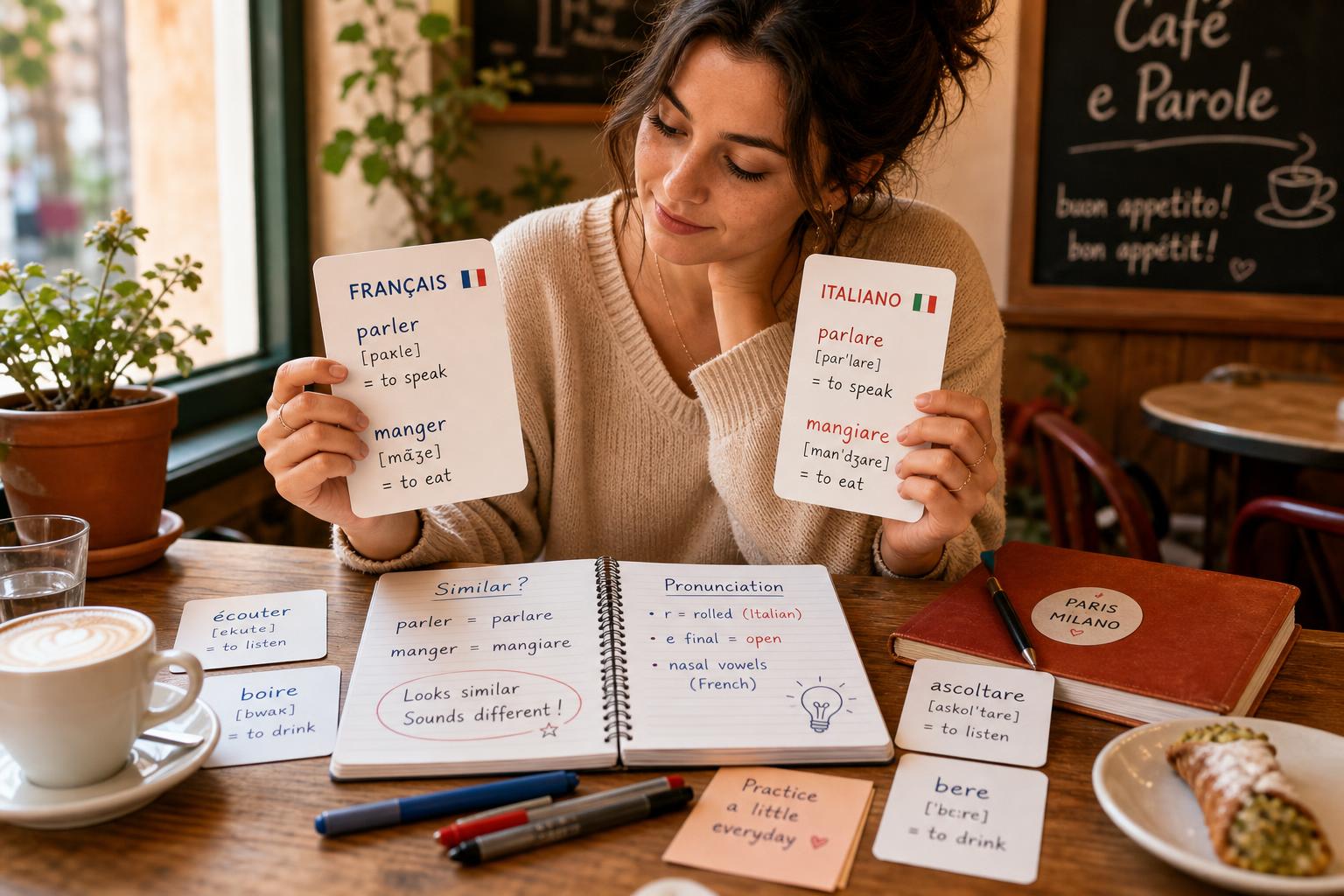
French and Italian both come from Latin, so they share a lot of grammar DNA. Both languages use grammatical gender, which means nouns are usually masculine or feminine. For example, French has un ami and une amie, while Italian has un amico and un’amica. Both languages also use articles that change with gender and number, such as le, les in French and il, la, i, le in Italian.
The biggest grammar difference for many learners is how the two languages handle sentences day to day. French often relies more on fixed forms and common constructions like il faut and on parle, while Italian often feels a little more flexible and expressive in everyday speech, especially with pronouns and verb endings. For example, French says je parle, tu parles, il parle; Italian says parlo, parli, parla. In Italian, the subject pronoun is often dropped because the verb ending already shows who is speaking.
| Topic | French | Italian | What to notice |
|---|---|---|---|
| Definite article, singular masculine | le livre | il libro | Both mark gender, but the forms differ. |
| I am speaking | je parle | parlo | Italian usually drops the subject pronoun. |
| There is / are | il y a | c’è / ci sono | Both have an existential structure, but it sounds different. |
| Negative form | ne … pas | non … | French wraps the verb; Italian is simpler in structure. |
| Future tense idea | je vais partir | partirò / andrò via | French often uses a helper construction in speech; Italian uses synthetic forms more often. |
A useful learner takeaway: French grammar can feel more “marked” by helper words and silent endings, while Italian grammar often feels more transparent because many endings are pronounced. But Italian still has plenty of details to master, especially gender agreement, plural forms, and reflexive verbs like lavarsi and se laver.
Vocabulary: Many Shared Origins, Many False Friends
Vocabulary is where French and Italian can look very similar at first glance. You will notice pairs like important / importante, nation / nazione, and possible / possible-possibile. This helps a lot when reading signs, menus, or simple articles. But the similarity can also be dangerous because some words look nearly identical but mean different things.
Here are a few classic false friends and near-friends that intermediate learners should watch carefully: French demander means “to ask,” while Italian domandare also means “to ask” in a formal sense, but French assister means “to attend,” while Italian assistere usually means “to assist” or “to care for.” French librairie is a bookstore, while Italian libreria is also a bookstore, which is helpful, but Italian biblioteca means library, not bookstore. Small differences like these matter in real conversations.
- French cuisine / Italian cucina — very close, easy win.
- French voiture / Italian macchina — both mean car in everyday use, but the roots differ.
- French chambre / Italian camera — both mean room, but Italian camera can also mean bedroom or chamber.
- French toujours / Italian sempre — both can mean always, but not every context matches perfectly.
- French actuellement / Italian attualmente — both mean currently, not “actually.”
For learners, the best strategy is to treat similarities as support, not proof. If a word looks familiar, confirm it in context. That habit prevents embarrassing mix-ups and helps you build vocabulary faster in both languages.
Pronunciation: Italian Is Usually More Transparent
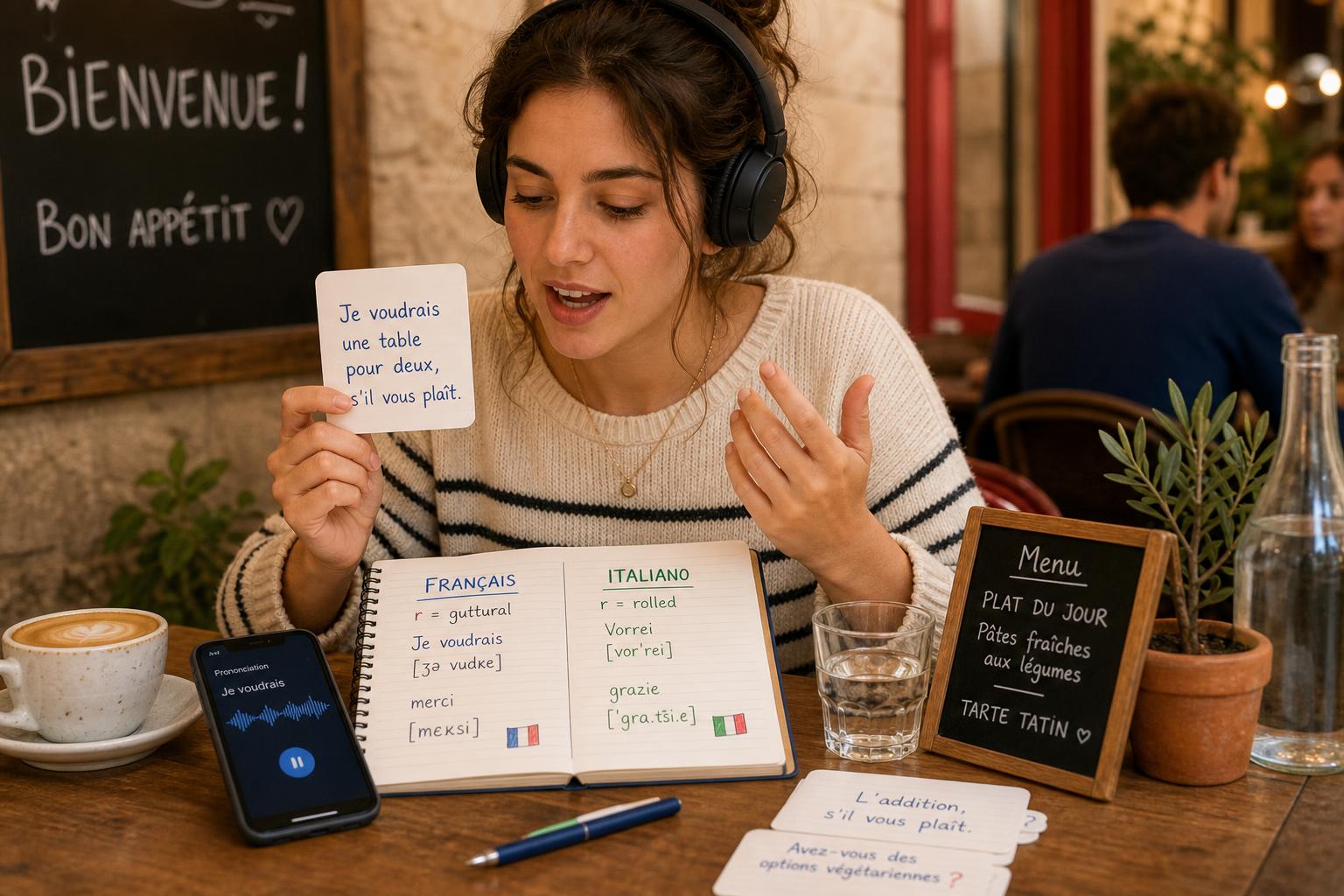
This is one of the biggest practical differences. Italian pronunciation is generally more regular: if you can read the word, you can often say it correctly. French is less predictable because many letters are silent and word endings are not always pronounced. Compare French beaucoup with Italian molto, or French parler with Italian parlare. In French, you often memorize spelling and sound together; in Italian, spelling gives you more clues.
French also has nasal vowels, like in bon and sans, which do not exist in standard Italian. Italian instead gives learners clear vowel sounds and strong consonants, especially double consonants. The contrast between caro and carro is a good example: in Italian, double consonants really change the word and must be pronounced carefully. French has its own rhythm and liaisons, where letters at the end of a word may connect to the next word, as in les amis.
If your goal is to sound natural quickly, Italian often feels more forgiving at the beginner stage because you can pronounce more of what you see. French may require more listening practice before your ear and mouth feel synchronized. That said, French can be very rewarding once you learn its rhythm, and Italian rewards clean, confident articulation.
Everyday Learning Difficulty: Which One Feels Easier?
There is no universal winner, but many English-speaking learners find Italian easier to start speaking, while French may feel easier to recognize in writing. Why? Italian pronunciation is more straightforward, and common phrases often map neatly onto everyday situations. French, on the other hand, can feel smoother to read because its spelling is familiar from English loanwords, but it may take longer to produce accurately.
- Italian advantage: clearer pronunciation and visible word endings.
- French advantage: lots of overlap with English in formal vocabulary.
- Italian challenge: double consonants, articles, and verb endings.
- French challenge: silent letters, liaison, and pronunciation exceptions.
A practical way to think about it: if you like speaking early and building confidence through sound, Italian often gives faster results. If you enjoy pattern recognition in reading and writing, French can be very satisfying. Either way, consistency matters more than the language you choose first.
Resources for Learning: What Helps With Each Language
For French, prioritize listening materials with transcripts, because pronunciation is the main barrier for many learners. Short dialogues, slow audio, and shadowing exercises help a lot. For Italian, prioritize phrase lists, speaking drills, and repetition of sentence patterns, because the language is highly usable once you memorize a few core structures.
If you are learning both languages, organize them by function. Use French resources for ear training and comprehension, and Italian resources for active speaking practice. For example, pair a French survival phrase guide with an Italian everyday travel guide so your brain does not confuse the two systems.
For a practical next step, compare your Italian study with this survival-focused phrase guide: Italian Phrases for Everyday Travel and Survival
A Simple Comparison Table for Intermediate Learners
| Area | French | Italian | Learner takeaway |
|---|---|---|---|
| Grammar | More fixed helper structures and silent endings | More pronounced endings and clearer verb forms | Italian often feels more transparent at first. |
| Vocabulary | Many words resemble English and Italian | Many words resemble French and Latin roots | Similarity helps, but false friends are common. |
| Pronunciation | Silent letters, nasal vowels, liaison | Clear vowels, double consonants, regular spelling | Italian is usually easier to say from the page. |
| Ease of learning | Great for reading and listening practice | Great for early speaking confidence | Choose based on your learning style. |
| Resources | Audio-heavy practice is especially useful | Phrase-based speaking resources work well | Use the right tool for the main challenge. |
The Bottom Line
French and Italian are siblings, not twins. They share a Latin foundation, many similar-looking words, and several parallel grammar ideas, but they diverge in pronunciation, sentence rhythm, and everyday usage. For an intermediate learner, that is actually a plus: once you notice the differences clearly, the similarities become much more useful.
The best path is simple: use comparisons, keep examples in pairs, and practice with short real phrases. The more you compare un ami with un amico, je parle with parlo, and beaucoup with molto, the faster the two languages will stop feeling confusing and start feeling familiar.