Italian Phrases for Everyday Travel and Survival
Ciao, explorers!
If your next adventure is taking you to the charming lanes of Italy, brimming with art, history, and gastronomy, adding a sprinkle of the local language to your itinerary could be the cherry on top of an already delightful experience!
When you venture into the heart of Italy, being equipped with some basic Italian phrases can prove to be more than just handy. It paves the way for richer interactions, warmer smiles, and a deeper connection with the local culture.
You’ll find that a little effort goes a long way, and the locals appreciate it immensely when you try to converse in their native tongue.
Essential Italian Phrases — A Summary
Ready to impress the locals with your Italian? Here is a nifty table of common Italian phrases that will serve as your trusty companion throughout your journey:
| Italian Phrase | English Meaning | Usage Notes |
|---|---|---|
| Ciao! | Hello / Hi and Goodbye / bye | Ciao is both “hello” and “goodbye” in Italy. |
| Salve | Hello | Used more often in some regions |
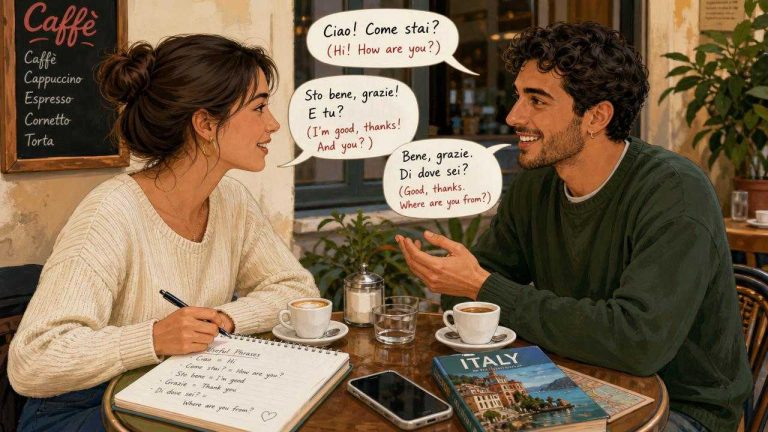
| Come va? | How’s it going? | General — can use with anyone |
| Come stai? | How are you? (informal) | Used with people you know |
| Buongiorno | Good morning | Used in the morning, until around 1 PM |
| Buonasera | Good evening | Used in the afternoon and evening |
| Buonanotte | Good night | Used late in the evening, only when saying goodbye |
| Grazie | Thank you | A universal way to express gratitude |
| Per favore Per favore | Please | Adds a polite touch to your requests (two variants) |
| Scusa (informal) Scusi (formal) | Excuse me | To catch someone’s attention or to apologize. Use the formal tone if the situation demands it. |
| Sì | Yes | To agree or affirm |
| No | No | To disagree or negate |
| Il conto, per favore | The bill, please | Requesting the bill in restaurants |
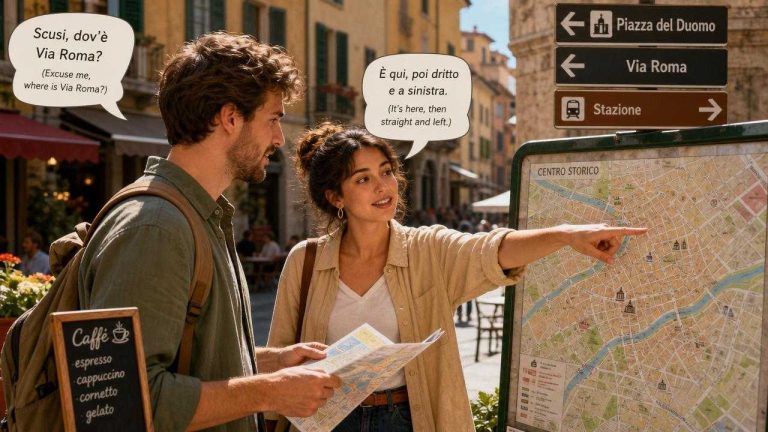
| Dove si trova…? | Where is…? | When asking for directions to something |
| Il bagno | The bathroom | Often used with “Dove si trova” to find restrooms |
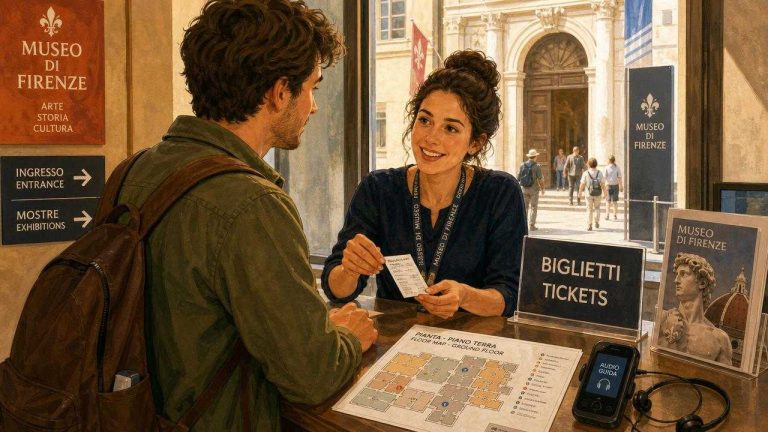
| Quanto costa questo? | How much does this cost? | To inquire about the price of something |
| Parli inglese? | Do you speak English? | Finding out if someone can communicate in English. In a formal tone. |
| Non ho capito | I don’t understand | When you need clarification |
| Mi dispiace | I’m sorry | To apologize or express regret |
| Permesso | Excuse me | To get past someone, e.g. on a tram or busy sidewalk |
| Aiutami | Help me | Seeking help in urgent situations |
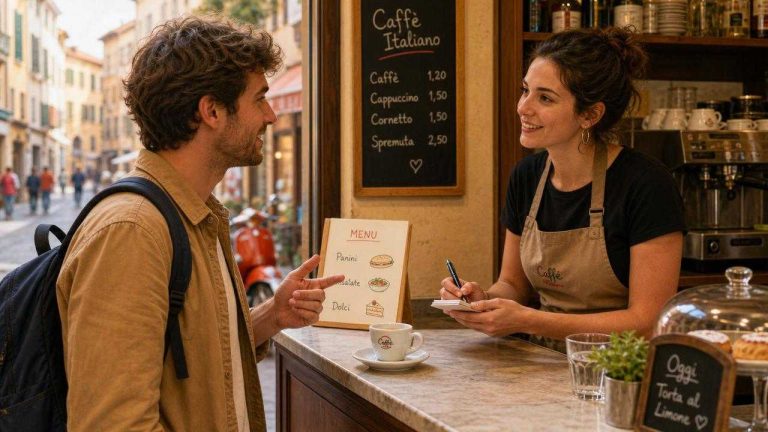
| Vorrei | I would like | To express a desire or request something |
| Dell’acqua, per favore | Water, please | When requesting water |
| Un gelato | An ice cream | … |
| Arrivederci | Goodbye | A general farewell phrase |
Tips to Charm Your Way Through Italy
Now that you’ve got these Italian phrases in your arsenal, here are some tips to enhance your Italian-speaking escapade:
- Pronunciation Mastery: Italian is a melodious language. Try to mimic the melody and rhythm to blend in seamlessly.
- A Friendly Gesture: A friendly nod or a smile can act as the perfect accessory to your newly learned phrases, making your interactions even more delightful.
- Politeness Matters: Italians admire good manners. Make sure to sprinkle your conversations with “per favore” and “grazie”.
- Engage Actively: Don’t hesitate to engage in casual banter. It could be a gateway to many beautiful local experiences.
- Seek Guidance: If you’re stuck, use “Aiutami” to ask for help. Remember, it’s okay to seek assistance.
Dive Deeper: Mastering Greetings, Politeness, and Gestures in Italy
Below are some more detailed notes on using the above Italian phrases.
Greetings to Win Hearts
While “Ciao” is universally recognized, Italy offers a rich tapestry of regional greetings that can charm the locals and bring a warm smile to their faces.
- “Salve” is a more formal yet friendly way to say hello, suitable for all times of the day.
- In Naples, you might hear a hearty “Guaglione” (young person), a term of endearment used among friends.
- If you’re in Sicily, don’t be surprised to hear “Salutamu” (we salute), a warm and traditional greeting.
The Art of Saying “Excuse Me”
Knowing how to say “Excuse me” appropriately can be a lifesaver in various situations. There are a few relevant Italian phrases. Here’s how to use them:
- Bumping into Someone: Use “Mi scuso” or “Scusa” as a way to apologize for a little bump or accidental nudge.
- Getting Past Someone: “Permesso” is what you say as you try to move past someone in a crowded place.
- Seeking Attention: When you need to catch someone’s attention, a polite “Scusami” should do the trick.
Polishing Your “Yes” and “No”
While “Sì” and “No” are straightforward responses, sometimes situations call for a softer touch, and the following Italian phrases may come in useful.
- Instead of a direct “yes”, you might use “Certo” (of course) or “Volentieri” (gladly) to convey willingness more warmly.
- To refuse politely, opt for “Mi dispiace, ma no” (I’m sorry, but no), to cushion the rejection with a touch of empathy.
Making Polite Requests
There are Italian phrases that can soften any first encounter. Master the art of making requests that ooze politeness with phrases like:
- “Posso chiedere qualcosa?” (May I ask something?) is a gentle prelude to your query.
- Asking permission is gracefully done with, “Potrei…?” (Could I…?).
Gestures and Tone: The Unspoken Language
Remember, communication is not just verbal. This goes more for Italian than it does for most major languages.
So aside from using the right Italian phrases in the right moments, here are a few tips to navigate the vibrant and expressive world of Italian gestures and tone:
- Warmth in Tone: Italians are known for their warm and friendly tone. Don’t hesitate to inject enthusiasm and warmth into your voice.
- Expressive Gestures: Don’t be surprised to see Italians using a rich repertoire of hand gestures along with their words. Feel free to express yourself with your hands too, it’s appreciated!
- Physical Greetings: Greetings in Italy often involve a friendly kiss on both cheeks, starting from the left. This generally happens among friends and family — people you’ve met before, or friends of friends.
- Maintaining Eye Contact: It’s customary to maintain eye contact during conversations as a sign of attentiveness and respect. (Worth mentioning, because in some cultures, direct eye contact is considered rude.)
So, with these tips and phrases at your disposal, you’re ready to navigate the enchanting Italian landscape like a pro, forging connections that transcend language barriers.
Remember, when in Italy, communicate with both your words and your heart. Buona fortuna!
Wrap up
Learning Italian is a rewarding endeavour. It opens up a world of natural beauty, art, culture, food, and much more.
The above Italian phrases should be a starting point, but there’s much more Italian to learn in the future.
So, go ahead and soak in the rich Italian culture with your newfound language skills. Buon viaggio e parla con coraggio!