How to Practice Italian for 10 Minutes a Day Without Burning Out
If you want to keep learning Italian but your schedule is already full, the answer is not a bigger study plan. It is a smaller one you can repeat tomorrow. Ten minutes a day is enough to build a real habit, stay consistent, and make Italian feel normal instead of stressful.
Why 10 minutes works better than 60 once a week
For beginners, the biggest problem is usually not effort. It is overload. A long study session can feel productive, but it is hard to repeat when life gets busy. A short daily routine lowers the pressure, keeps the language fresh, and helps you remember words because you keep meeting them in small, spaced-out doses.
- You are more likely to start when the task feels easy.
- You review words before they fade from memory.
- You build a habit you can keep on travel days, workdays, and low-energy days.
- You avoid the “all or nothing” feeling that causes burnout.
A simple 10-minute Italian routine
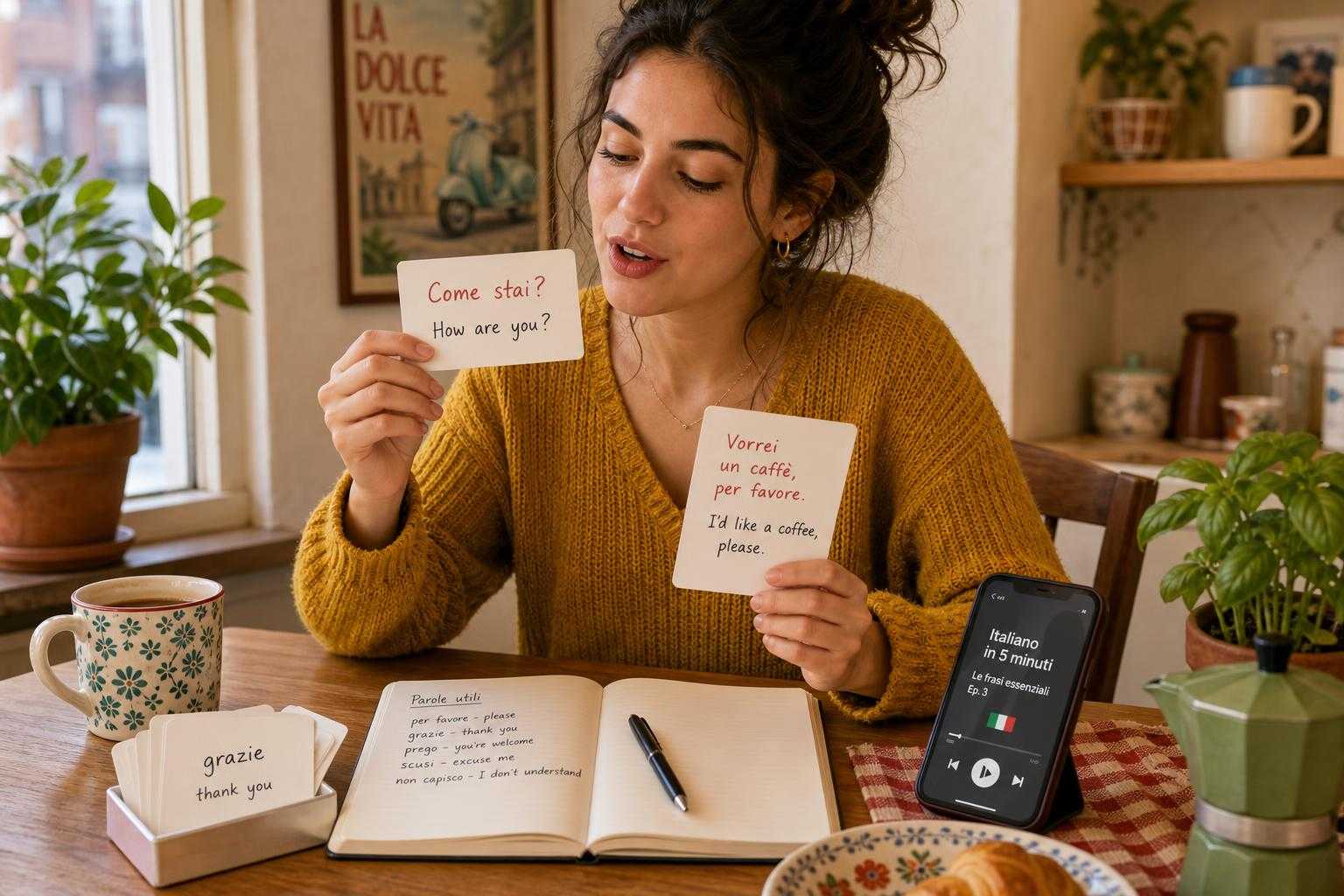
Use the same basic structure each day so you do not have to think about what comes next. Do the same simple steps each day so you do not waste energy deciding what to study. Here is a practical routine you can use with any beginner topic, from ordering coffee to asking for directions.
| Time | What to do | Example |
|---|---|---|
| 2 minutes | Review 5 phrases | Ho una prenotazione. |
| 3 minutes | Listen to a short clip | A café or hotel dialogue |
| 2 minutes | Shadow one line | Repeat after the speaker |
| 2 minutes | Say it without looking | Cover the phrase and try again |
| 1 minute | Use it in one sentence | Prendo un cappuccino. |
If you want more phrases to plug into this routine, try this guide to Italian Everyday Expressions to Sound Local
Useful Italian phrases to plug into the routine
Use the 10-minute routine with phrases you might actually need while travelling. Start with one small situation, such as ordering coffee, asking for directions, or checking into a hotel.
| Situation | Italian phrase | English meaning |
|---|---|---|
| Café | Buongiorno, prendo un caffè. | Good morning, I’ll have a coffee. |
| Café | Quanto costa? | How much does it cost? |
| Directions | Scusi, dov’è la stazione? | Excuse me, where is the station? |
| Directions | È lontano? | Is it far? |
| Hotel | Ho una prenotazione. | I have a booking. |
| Help | Scusi, parla inglese? | Excuse me, do you speak English? |
Do not try to memorize all of them at once. Pick three phrases, say them out loud, and reuse them for a few days before adding more.
Use spaced repetition without making it feel like homework
Spaced repetition sounds technical, but the idea is simple: review a word or phrase again just before you are about to forget it. That is why a few short reviews beat one big cram session. For Italian beginners, this works especially well with useful chunks like “Vorrei un caffè” or “Quanto costa?” because you are learning language that is easy to reuse in real life.
| Day | What to do | Goal |
|---|---|---|
| Monday | Review 5 phrases | Re-activate older words |
| Tuesday | Listen and repeat | Hear the phrases in context |
| Wednesday | Use the phrases in one sentence | Make the words active |
| Thursday | Review the same set again | Strengthen recall |
| Friday | Mix in 2 new phrases | Add a small amount of new material |
Micro-listening: learn from tiny audio clips
You do not need long podcasts to improve. A 20- to 60-second clip is enough if you listen with a clear job in mind. First, listen for the main idea. Then listen again for one phrase you want to steal. Finally, repeat only the useful line instead of trying to understand every single word.
- Choose a short dialogue or sentence-based lesson.
- Listen once without pausing.
- Listen again and write down one phrase.
- Repeat the phrase aloud three times.
- Use it later in a real or pretend situation.
Shadowing for natural rhythm and pronunciation
Shadowing means speaking right after the audio, almost like you are following it in real time. It is one of the best low-pressure ways to improve sound and rhythm because you are not inventing language from scratch. You repeat the sentence until the rhythm feels less strange.
Start with short lines and make them practical. For example: “Buongiorno, vorrei un cappuccino.” “Scusi, dov’è la stazione?” “Scusi, parla inglese?” These are short enough to repeat, and useful enough to matter when you actually need them.
Low-pressure speaking practice you can do alone
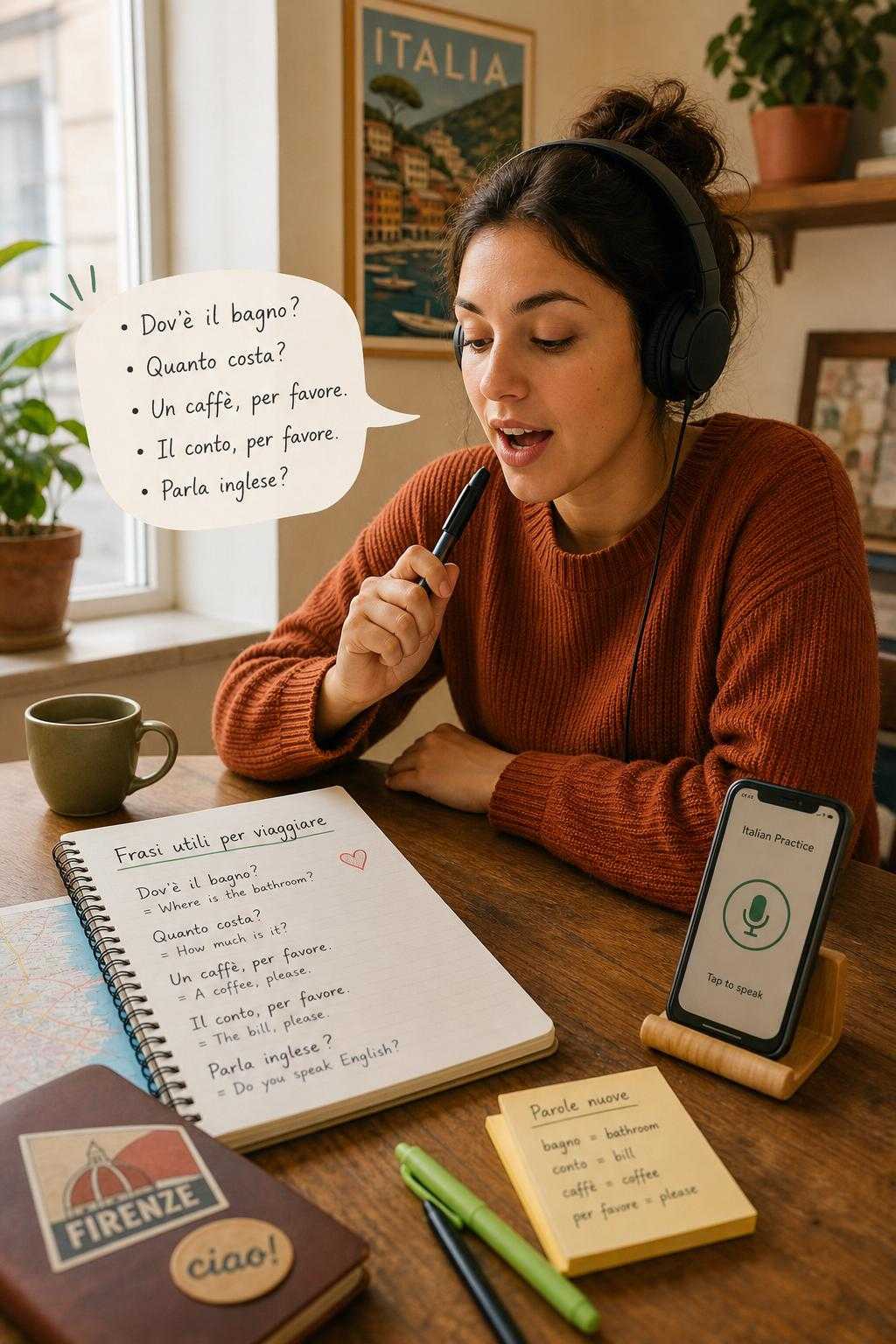
You do not need a conversation partner every day. You just need a way to produce Italian out loud without freezing. Try answering simple prompts from your own life: what you want for breakfast, where you are going, what you need at the train station, or what you are ordering at a café.
- Say three things you need today in Italian.
- Describe what you see in the room using very simple words.
- Practice one mini-dialogue for a café, hotel, or shop.
- Record yourself once and replay it without judging your accent.
- Replace one English sentence in your day with Italian.
For more ready-to-use language in real situations, see Italian Phrases for Everyday Travel and Survival
A better goal: usable Italian, not perfect Italian
Ten minutes a day will not make you fluent overnight. But it can help you remember the phrases you actually need: ordering a coffee, asking where something is, checking into a hotel, or asking for help politely.
Start with three to five phrases and practice them out loud for a week. Keep the routine small enough that you can do it even on a busy day.
You do not need perfect Italian to communicate well. If you can greet someone, ask one clear question, and understand a simple answer, your practice is already doing its job.