French at a Brussels Café: Ordering in a Multilingual City
In a Brussels café, French can get you from the first greeting to a clear coffee order. Start with “Bonjour,” name the drink you see on the menu, and wait for the reply. If the staff member begins in Dutch or English, follow the language you share rather than treating French as the default for every person.
The short version: “Bonjour. Je voudrais un café filtre, s’il vous plaît. Sur place.” That means “Hello. I’d like a filter coffee, please. To have here.” You can replace café filtre with the drink this café actually sells.
The first five lines to learn
These polite French lines suit a straightforward café order in Brussels. Use vous with staff; it keeps the request courteous without sounding stiff.
| French | English and when to use it |
|---|---|
| Bonjour. | Hello. Begin the exchange. |
| Je voudrais un café filtre, s’il vous plaît. | I’d like a filter coffee, please. Order a drink on the menu. |
| Sur place, merci. | To have here, thanks. Reply when staff ask where you’ll drink it. |
| Je peux payer par carte ? | Can I pay by card? Check before relying on a card. |
| Pardon, vous pouvez répéter plus lentement ? | Sorry, can you repeat that more slowly? Use when you miss a reply. |
Read the room before ordering
The Brussels-Capital Region describes itself as officially bilingual because French and Dutch speakers live there. That status doesn’t tell you which language the person behind a particular counter prefers. Read the menu and listen to the greeting. An English menu also doesn’t guarantee that every staff member works in English.
If the exchange starts in French, answer in French. If someone opens in Dutch and you don’t speak it, try “Pardon, est-ce que vous parlez français ?” (“Sorry, do you speak French?”). If the answer is no and you share English, switch with a simple “Is English okay?” Don’t make the staff member explain their language choice.
Order the coffee you actually want
Visit Brussels lists espresso and filter coffee among the city’s café options and describes drinks served sur place or à emporter. A café’s own menu decides what it offers, so say the drink’s name rather than assuming “un café” gives you the same cup everywhere. If you point to a menu item, “Je voudrais celui-ci, s’il vous plaît” means “I’d like this one, please.”
You may hear “Sur place ou à emporter ?” (“For here or to take away?”). Reply “Sur place, merci” or “À emporter, s’il vous plaît.” The latter is for a drink to go. The city visitor guide uses both terms in its Brussels café descriptions, so they belong in this setting.
Hear the question, then give a short answer
Staff may ask “Vous désirez autre chose ?” (“Would you like anything else?”). You can say “Non, merci, c’est tout” (“No, thanks, that’s all”). If you need another moment to choose, “Une seconde, s’il vous plaît” (“One second, please”) buys you time without a long explanation.
Here is a practice exchange for a café that sells filter coffee. It covers the order, the follow-up, and the choice to stay:
| French exchange | English |
|---|---|
| You: Bonjour. Je voudrais un café filtre, s’il vous plaît. | Hello. I’d like a filter coffee, please. |
| Staff: Sur place ou à emporter ? | For here or to take away? |
| You: Sur place, merci. | For here, thanks. |
| Staff: Vous désirez autre chose ? | Would you like anything else? |
| You: Non, merci, c’est tout. | No, thanks, that’s all. |
If you don’t catch a question, say “Pardon, vous pouvez répéter plus lentement ?” If it is the price you missed, ask “Vous pouvez me montrer le prix ?” (“Can you show me the price?”). Repeat the amount back before you pay if you are unsure.
Pay, and leave the exchange in good shape
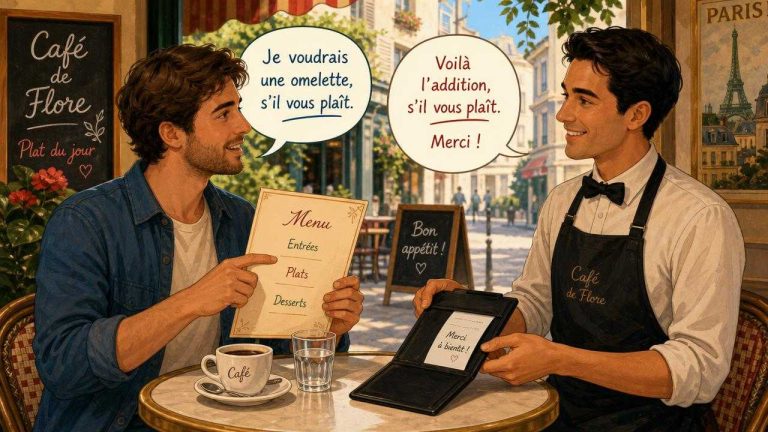
At a table, “L’addition, s’il vous plaît” asks for the bill. At a counter, “Je peux payer ici ?” asks whether you pay there. Ask “Je peux payer par carte ?” before you rely on a card; payment options belong to the café, not the city as a whole. Finish with “Merci, au revoir.”
For pronunciation, say café as two clear syllables, with the final syllable stronger. The final t in plaît is silent.
Practise the greeting, your chosen drink, and “Sur place” as a single exchange. For a broader set of greetings and repair phrases, use the French travel phrase guide.