French Restaurant Phrases for Ordering and Paying
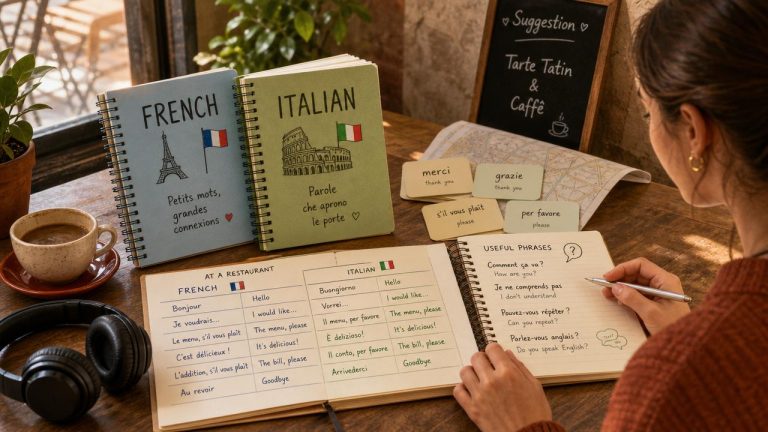
If you want to order in French without freezing up, this guide gives you the phrases you actually need: getting a table, ordering food and drinks, asking what’s recommended, making simple changes, and paying the bill.
You do not need long sentences to eat out in French. A few polite, reusable phrases will help you handle most restaurant situations.
If you also want a wider set of survival phrases for everyday situations, take a look at this guide to French Phrases for Everyday Survival (With Audio).
If you also want a wider set of survival phrases for everyday situations, take a look at this guide to French Phrases for Everyday Survival (With Audio)
Quick restaurant cheat sheet
These are the core phrases to know before you walk into a French restaurant. You can use them even if you do not understand the whole conversation. Start with these, then add more specific phrases from the sections below.
| Situation | French | English |
|---|---|---|
| Getting a table | Une table pour deux, s’il vous plaît. | A table for two, please. |
| Reservation | J’ai une réservation au nom de [nom]. | I have a reservation under [name]. |
| Ordering | Je voudrais ça, s’il vous plaît. | I’d like this, please. |
| Recommendation | Qu’est-ce que vous conseillez ? | What do you recommend? |
| Water | Une carafe d’eau, s’il vous plaît. | A carafe of tap water, please. |
| Allergy | Je suis allergique aux fruits à coque. | I’m allergic to tree nuts. |
| Paying | L’addition, s’il vous plaît. | The bill, please. |
Polite basics before you order
In France, it is normal to start with Bonjour. before asking for anything. This matters in restaurants, cafés, bakeries, and shops. Even if the rest of your French is very simple, a polite greeting makes the exchange feel much smoother.
| French | English | Notes |
|---|---|---|
| Bonjour. | Hello. | Use during the day when you enter or first speak to the server. |
| Bonsoir. | Good evening. | Use later in the day. |
| S’il vous plaît. | Please. | Polite and essential. |
| Merci. | Thank you. | Simple and natural. |
| Excusez-moi. | Excuse me. | Use this to get someone’s attention politely. |
If you also want a wider set of polite phrases, take a look at this guide to French Etiquette Phrases for Polite Everyday Interactions
Getting a table
Use these phrases when you arrive at a restaurant and need a table. You might be asked whether you have a reservation, how many people you are, or whether you want to sit inside or outside. Keep your answer short and clear.
| French | English |
|---|---|
| Une table pour deux, s’il vous plaît. | A table for two, please. |
| Vous avez une table pour deux ? | Do you have a table for two? |
| J’ai une réservation au nom de [nom]. | I have a reservation under [name]. |
| Pour deux personnes, s’il vous plaît. | For two people, please. |
| On peut s’asseoir en terrasse ? | Can we sit outside? |
| On peut s’asseoir à l’intérieur ? | Can we sit inside? |
Ordering food and drinks
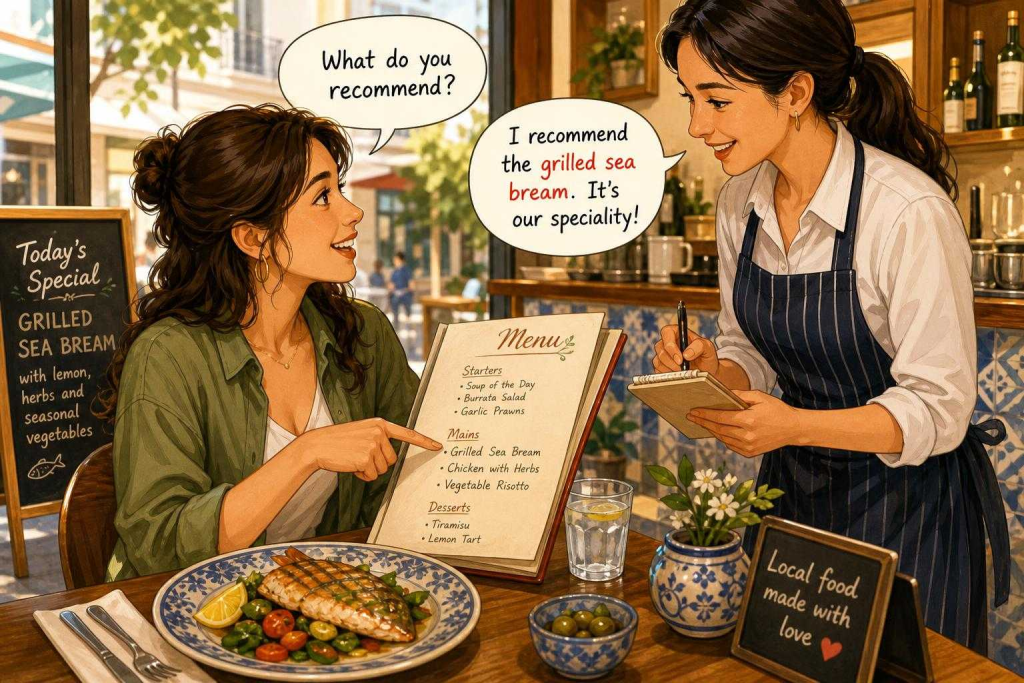
The easiest ordering phrase is Je voudrais… It means “I’d like…” and works well for food, drinks, and simple requests. Je prendrai… means “I’ll have…” and also sounds natural when ordering from a menu.
| French | English |
|---|---|
| Je voudrais la soupe, s’il vous plaît. | I’d like the soup, please. |
| Je prendrai le steak. | I’ll have the steak. |
| Je voudrais ça, s’il vous plaît. | I’d like this, please. |
| Une carafe d’eau, s’il vous plaît. | A carafe of tap water, please. |
| Un verre de vin rouge, s’il vous plaît. | A glass of red wine, please. |
| Un café, s’il vous plaît. | A coffee, please. |
| Je peux avoir la carte, s’il vous plaît ? | Can I have the menu, please? |
Asking what to order
If you are not sure what to choose, asking for a recommendation is completely normal. Qu’est-ce que vous conseillez ? is a useful, polite question that works in most restaurants. You can also ask about a starter or main course if you want more specific help.
| French | English | Notes |
|---|---|---|
| Qu’est-ce que vous conseillez ? | What do you recommend? | Natural and useful. |
| Qu’est-ce que vous recommandez ? | What do you recommend? | Also correct and polite. |
| Quelle est la spécialité de la maison ? | What is the house specialty? | Useful in traditional restaurants. |
| Qu’est-ce que vous recommandez en entrée ? | What do you recommend for a starter? | Good if you want help choosing the first course. |
| Qu’est-ce que vous recommandez en plat ? | What do you recommend for a main course? | Useful for choosing the main dish. |
Asking for small changes
For simple changes, use sans, which means “without.” This is often easier than trying to build a long sentence. For sauce or dressing on the side, French uses à part, meaning “separately.”
| French | English |
|---|---|
| Sans oignons, s’il vous plaît. | No onions, please. |
| Sans fromage, s’il vous plaît. | Without cheese, please. |
| Sans sauce, s’il vous plaît. | Without sauce, please. |
| La sauce à part, s’il vous plaît. | Sauce / dressing on the side, please. |
| Est-ce que je peux changer l’accompagnement ? | Can I change the side dish? |
Allergies and dietary needs
If you have an allergy, say it clearly before ordering. Do not worry about making the sentence fancy. The important thing is to name the ingredient clearly and make sure the server understands.
| French | English | Notes |
|---|---|---|
| Je suis allergique aux fruits à coque. | I’m allergic to tree nuts. | Better than noix for a general tree nut allergy. |
| Je suis allergique aux arachides. / Je suis allergique aux cacahuètes. | I’m allergic to peanuts. | Arachides is more formal; cacahuètes is common everyday French. |
| Je ne mange pas de viande. | I don’t eat meat. | Useful for vegetarians or anyone avoiding meat. |
| C’est végétarien ? | Is this vegetarian? | Short and common. |
| Ce plat contient du gluten ? | Does this dish contain gluten? | Natural when asking about one dish. |
| C’est sans gluten ? | Is it gluten-free? | Short and practical. |
Useful things the server may say
A restaurant exchange is easier when you recognise a few common questions. You do not need to understand every word. Listen for the key phrase, then use a short reply.
| French you may hear | English meaning | Simple reply | Simple reply in English |
|---|---|---|---|
| Vous avez réservé ? | Do you have a reservation? | Oui, au nom de [nom]. / Non. | Yes, under [name]. / No. |
| Pour combien de personnes ? | For how many people? | Pour deux personnes. | For two people. |
| Vous avez choisi ? | Have you decided? | Oui. / Pas encore. | Yes. / Not yet. |
| Vous voulez boire quelque chose ? | Would you like something to drink? | Une carafe d’eau, s’il vous plaît. | A carafe of tap water, please. |
| C’est tout ? | Is that everything? | Oui, merci. | Yes, thank you. |
| Vous voulez le ticket ? | Do you want the receipt? | Oui, merci. / Non, merci. | Yes, thank you. / No, thank you. |
Paying the bill
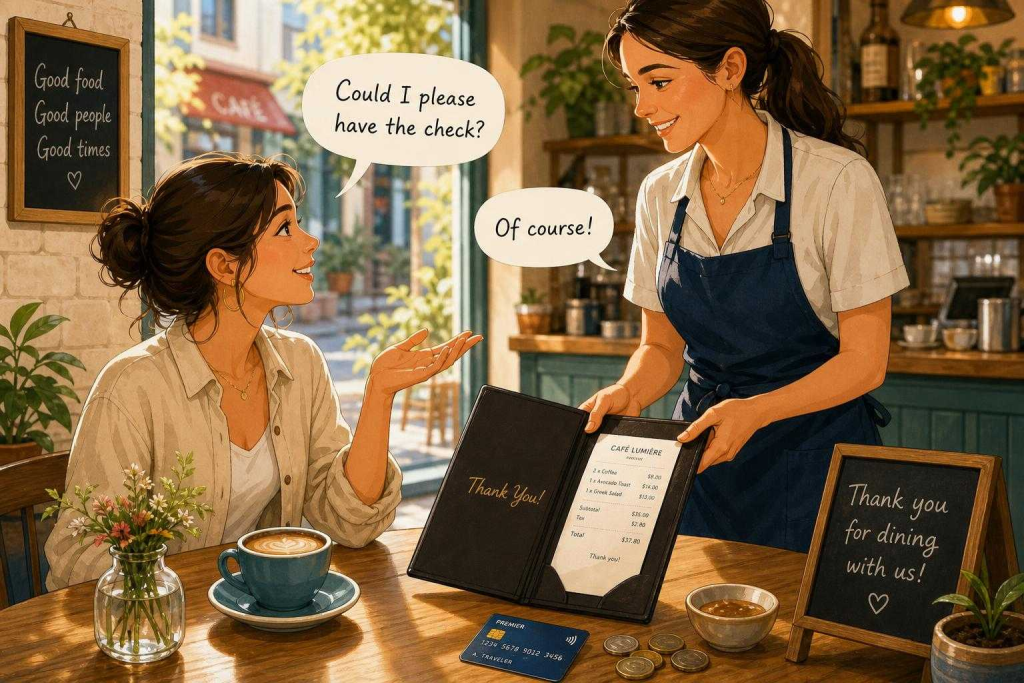
In France, the server will not always bring the bill automatically. When you are ready to pay, ask directly and politely. L’addition, s’il vous plaît. is the standard phrase, and you can use it in almost any restaurant or café.
| French | English |
|---|---|
| L’addition, s’il vous plaît. | The bill, please. |
| Je peux payer par carte ? | Can I pay by card? |
| On peut payer séparément ? | Can we pay separately? |
| Je règle où ? | Where do I pay? |
| Gardez la monnaie. | Keep the change. |
| Merci, c’était très bon. | Thank you, it was very good. |
Useful menu words
French menus have a few words that can confuse English speakers. The biggest one is menu, which often means a set menu or fixed-price meal, not the whole list of dishes. La carte is the word you usually want for the menu itself.
| French word or sign | English meaning | Why it helps |
|---|---|---|
| La carte | Menu / list of dishes | Use this when asking for the menu. |
| Menu | Set menu / fixed-price menu | In France, menu often means a set meal, not the whole menu. |
| Entrée | Starter / appetizer | In France, entrée usually means the first course, not the main course. |
| Plat | Main course | Useful when choosing the main dish. |
| Plat du jour | Dish of the day | Often a good value option. |
| Dessert | Dessert | Easy to spot at the end of the meal. |
| Boissons | Drinks | Useful for finding the drinks section. |
| Sans | Without | Handy for substitutions and allergies. |
A simple restaurant conversation
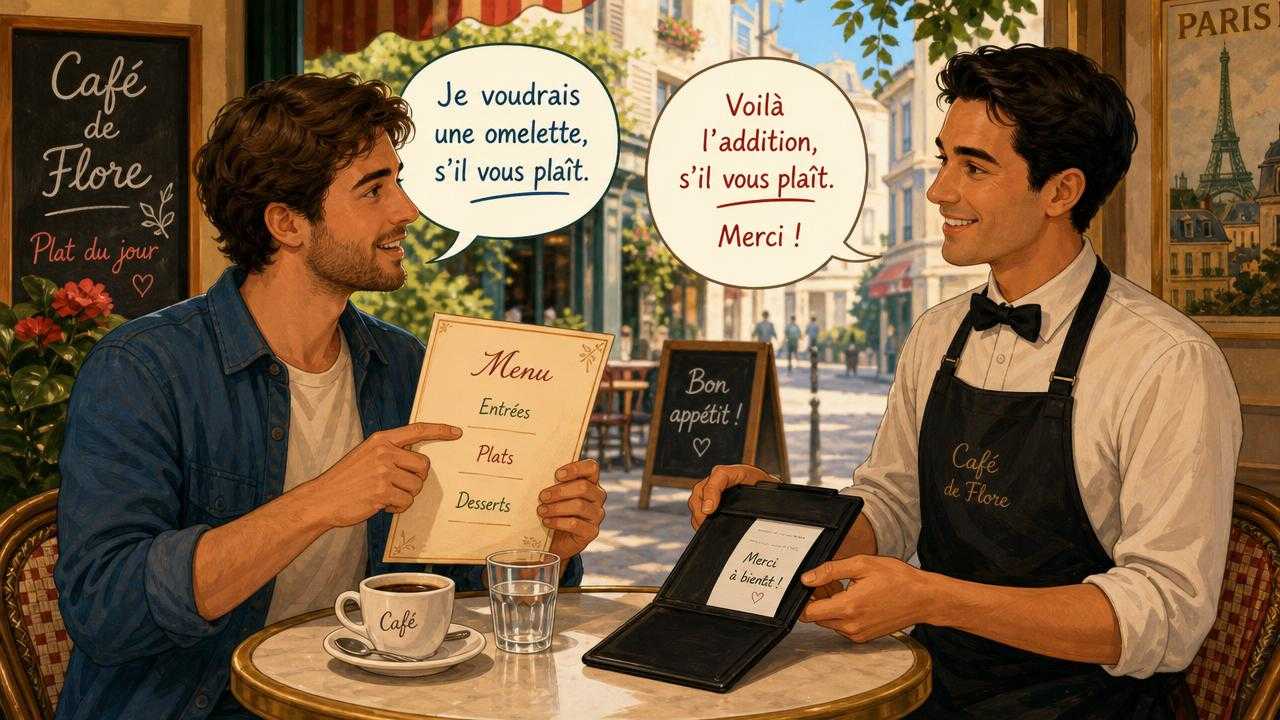
This short exchange shows how the phrases can work together in a real restaurant. You do not need to say much to be understood. Practice it out loud a few times so the order of the phrases feels familiar.
| French | English |
|---|---|
| Client : Bonjour. Une table pour deux, s’il vous plaît. | Customer: Hello. A table for two, please. |
| Serveur : Vous avez réservé ? | Server: Do you have a reservation? |
| Client : Non. | Customer: No. |
| Serveur : Vous avez choisi ? | Server: Have you decided? |
| Client : Oui. Je voudrais la soupe et une carafe d’eau, s’il vous plaît. | Customer: Yes. I’d like the soup and a carafe of water, please. |
| Serveur : C’est tout ? | Server: Is that everything? |
| Client : Oui, merci. | Customer: Yes, thank you. |
| Client : L’addition, s’il vous plaît. | Customer: The bill, please. |
| Client : Je peux payer par carte ? | Customer: Can I pay by card? |
| Client : Merci, c’était très bon. | Customer: Thank you, it was very good. |
Final recap
You do not need perfect French to order in a restaurant. Start with Bonjour., use Je voudrais… for ordering, and ask for the bill with L’addition, s’il vous plaît. If you need a change, sans is your most useful word.
Practice a few phrases out loud before your trip. Even short, simple French can make the whole restaurant experience feel much easier.