Spanish for Your First Buenos Aires Milonga
At a Buenos Aires milonga, you can take a class, watch the social dancing, and decide when you want to join in. Start by asking whether the class suits beginners. Once the music starts, watch how this room handles invitations before you invite anyone to dance.
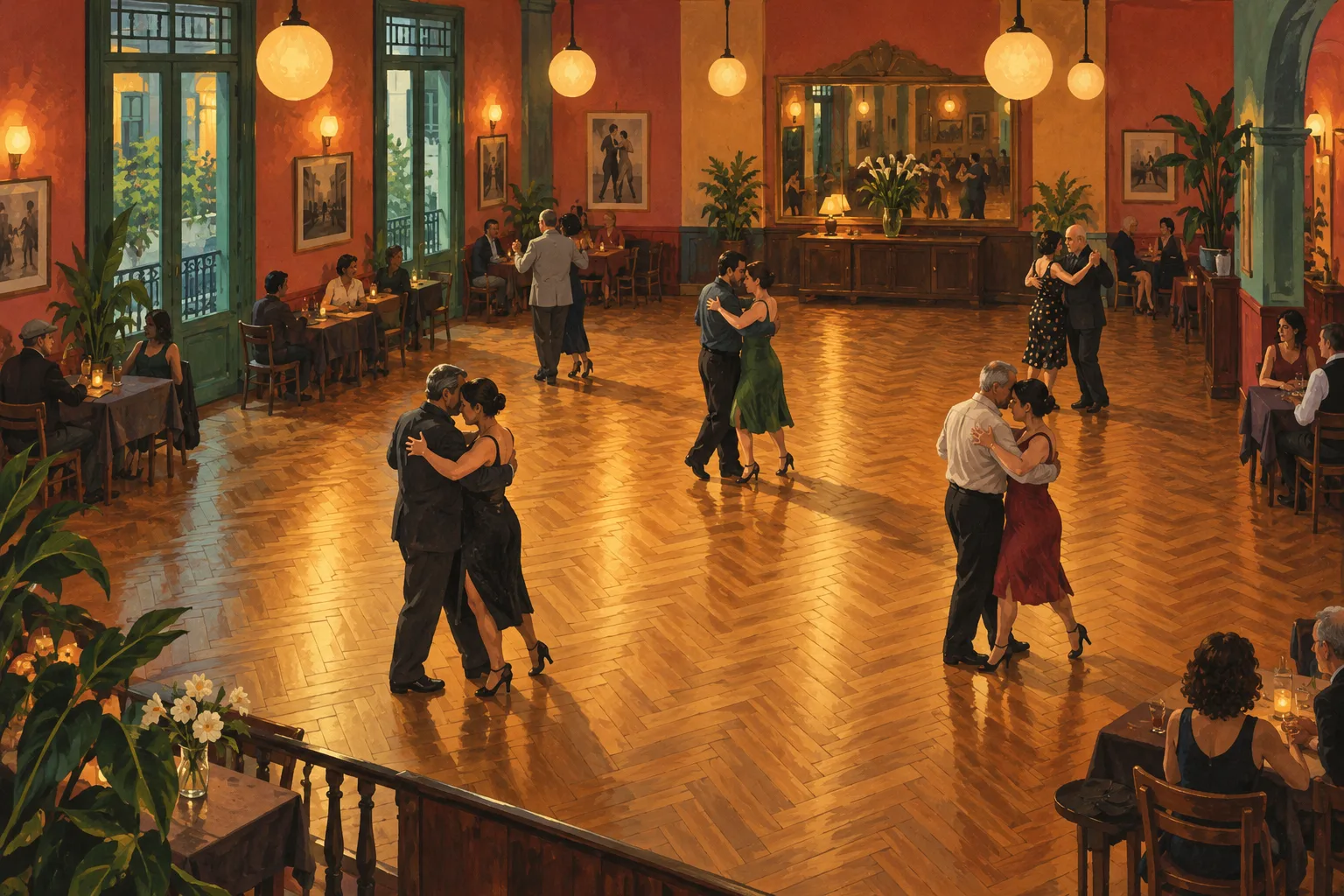
La Viruta Tango Club, at Armenia 1366 in Palermo, lists tango classes followed by dancing on its site. That gives this guide a real first-night setting; the exchanges below are practice examples, not a transcript of its staff or a promise about a future programme. Check the venue’s current class level, night and entry details before you go.
Seven lines for your first night
These lines use Buenos Aires Spanish. Querés and podés are informal vos forms, common in Argentina. Speak to an organiser politely, then let the other dancer decide whether they want to join you.
| Say this | Meaning and moment |
|---|---|
| ¿Esta clase es para principiantes? | Is this class for beginners? Ask before joining. |
| ¿Puedo quedarme a mirar después? | Can I stay and watch afterwards? |
| ¿Hay una práctica esta noche? | Is there a practice tonight? Check the programme. |
| ¿Qué música viene ahora? | What music comes next? Ask during a pause before deciding whether to dance. |
| ¿Cómo se invita a bailar acá? | How do people invite someone to dance here? Ask the host. |
| ¿Querés bailar? | Would you like to dance? Use when a spoken invitation fits this room and the person seems open to one. |
| Perdón, ¿me lo podés repetir más despacio? | Sorry, could you repeat that more slowly? Repair a missed reply. |
Choose a class, a practice or the social dance
A clase is a lesson with a teacher. A práctica gives dancers time on the floor to try what they’re learning; some practices also include a class. A milonga is the social dance event, which may have a lesson before the dancing. Buenos Aires defines the event around social tango dancing, and the local milonga organisers’ association lists beginner classes at both milongas and practices. The labels tell you about the programme, but each organiser sets the atmosphere.
There’s one extra language trap: milonga can also name a dance rhythm. La Viruta’s schedule lists a “clase de milonga” on one night and a later tango class. If you want a first tango lesson, ask ¿Esta clase es para principiantes? and let the teacher tell you what it covers. The published schedule can change, so confirm it with the venue before travelling.
At the social dance, songs come in tandas, short sets that may be tango, vals or milonga. Before joining the next set, ask ¿Qué música viene ahora? if you want to know what you’ll dance. Larrocca’s guide describes the different sets and pauses between them.
At the door, ¿Puedo quedarme a mirar después? lets you ask whether you may watch the dancing after class. The answer may depend on the night’s entry arrangement; don’t assume the class and social dance use the same ticket. If you want more practice rather than a social night, ask ¿Hay una práctica esta noche? and check the organiser’s answer.
Ask how invitations work in this room
Some Buenos Aires milongas use mirada (eye contact) and a small cabeceo (nod) to invite and accept a dance. María Ignacia Larrocca’s University of La Plata tango-Spanish guide describes that exchange and also says the codes change between milongas, nights and groups. The city’s milonga oral-history book records rooms where people invite at the table instead. Don’t impose one custom on every floor.
Ask the organiser ¿Cómo se invita a bailar acá? and observe a round of dancing. If people use eye contact and nods, wait for a clear response before walking over. If spoken invitations suit a practice or a conversation you’ve already started, ¿Querés bailar? is a short informal question. Larrocca’s local teaching material gives that exact form. The RAE and ASALE explain vos as an informal form in Argentina.
The answer can be Sí, gracias (“Yes, thanks”) or No, gracias. Prefiero mirar por ahora (“No, thanks. I’d rather watch for now”). Accept either answer at once. Buenos Aires tango teacher Analía Centurión writes that a dancer may decline an invitation or stop if they feel uncomfortable. A person who avoids eye contact hasn’t invited a follow-up pitch.
Practise both sides of the exchange
This sample conversation shows the questions you can ask a host at a class-and-dance night. Its replies are illustrative; follow the organiser’s actual answer.
| At the venue | English |
|---|---|
| You: Buenas. ¿Esta clase es para principiantes? | Hello. Is this class for beginners? |
| Host: Sí. Después empieza el baile. | Yes. The dancing starts afterwards. |
| You: ¿Puedo quedarme a mirar después? | Can I stay and watch afterwards? |
| Host: Sí, claro. | Yes, of course. |
| You: ¿Cómo se invita a bailar acá? | How do people invite someone to dance here? |
| Host: Primero mirá cómo lo hacen acá. | First watch how they do it here. |
If someone approaches you to dance and you want to wait, say No, gracias. Prefiero mirar por ahora. You don’t owe an explanation. If you miss the host’s reply, use Perdón, ¿me lo podés repetir más despacio? The request uses the same informal vos form as querés; ¿Me lo puede repetir más despacio? is a courteous alternative.
Say the names clearly, then listen
Stress the middle syllable in milonga (mi-LON-ga), the first in práctica (PRÁC-ti-ca), and the last in querés (que-RÉS). In Buenos Aires Spanish, the c in cabeceo before e sounds like an s; say ca-be-SE-o. These spelling hints are a start, not a recording of a local speaker. There’s no inline audio here because a Buenos Aires Spanish voice and its output haven’t been checked by ear.
Before your visit, practise the beginner-class question and the slower-repeat request. At the venue, ask the host about invitations and watch before you join the floor. For greetings and other everyday repair lines, see the Spanish travel phrase guide; its existing audio uses a Colombian voice, not a Buenos Aires one.