French Phrases for Train Travel, Platforms, and Tickets
Start with the phrases you need most
If you are taking a train in France, the most useful French is usually short, polite, and very specific. You do not need perfect grammar to get where you are going. You mainly need to ask for the platform, confirm the right train, and understand basic station announcements.
If you want a broader set of beginner travel phrases, you may also like French Phrases for Everyday Survival (With Audio). It pairs well with the train vocabulary in this post.
Quick survival phrases for French train stations
If you only learn a few phrases before your trip, start with these. They cover the most common moments: finding the right platform, checking the train, and asking for help.
| French phrase | English |
|---|---|
| Le train pour Lyon part de quelle voie ? | Which platform/track does the train to Lyon leave from? |
| C’est bien le train pour Bordeaux ? | Is this the train to Bordeaux? |
| Ce train s’arrête à Avignon ? | Does this train stop at Avignon? |
| Il faut changer ? | Do I need to change? |
| Vous pouvez m’aider, s’il vous plaît ? | Can you help me, please? |
Finding the right platform or track
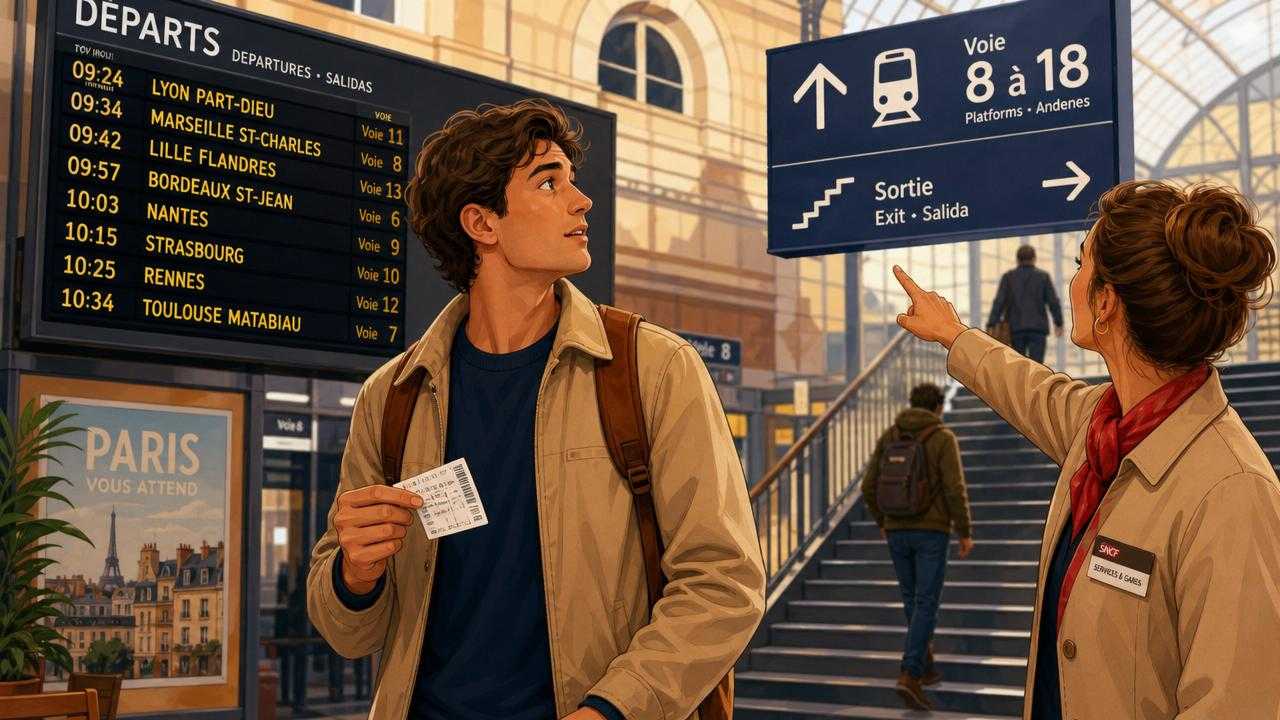
In French train stations, you will often see voie on the departure board. It means the track or platform number your train leaves from. Quai means the physical platform. If you mix them up, people will usually still understand you, but voie is especially useful when checking departures.
| French phrase | English |
|---|---|
| Où est la gare ? | Where is the station? |
| Où sont les quais ? | Where are the platforms? |
| Le train pour Lyon part de quelle voie ? | Which platform/track does the train to Lyon leave from? |
| Le train part d’ici ? | Does the train leave from here? |
| C’est bien le train pour Lyon ? | Is this the train to Lyon? |
| Ce train va bien à Marseille ? | Does this train definitely go to Marseille? |
| Ce train s’arrête à Avignon ? | Does this train stop at Avignon? |
| C’est direct ? | Is it direct? |
| Il faut changer ? | Do I need to change? |
A quick ticket vocabulary check
Before you buy a train ticket in French, it helps to recognize a few common words. You may see these on ticket machines, apps, departure boards, or printed tickets.
| French | English |
|---|---|
| un billet | a ticket |
| aller simple | one-way |
| aller-retour | round-trip |
| la deuxième classe | second class |
| le quai | the platform |
Buying tickets without stress

Ticket counters, machines, and apps can all feel fast in a busy station. A few simple phrases make it easier to ask for the fare you need and avoid the wrong ticket type.
| French phrase | English |
|---|---|
| Un billet pour Paris, s’il vous plaît. | A ticket to Paris, please. |
| Un aller simple pour Paris, s’il vous plaît. | A one-way ticket to Paris, please. |
| Un aller-retour pour Paris, s’il vous plaît. | A return ticket to Paris, please. |
| Un billet en seconde, s’il vous plaît. | A second-class ticket, please. |
| À quelle heure est le prochain train ? | What time is the next train? |
| Combien coûte le billet ? | How much is the ticket? |
| Je peux payer par carte ? | Can I pay by card? |
| Je peux prendre ce train avec ce billet ? | Can I take this train with this ticket? |
For more everyday phrases that help in real travel situations, see French Phrases for Everyday Survival (With Audio)
What you might hear at the ticket counter
These are useful to recognize. You may hear them from staff at the counter or see similar wording on a ticket machine.
| French phrase | English |
|---|---|
| Aller simple ou aller-retour ? | One-way or return? |
| En première ou en seconde ? | First class or second class? |
| Vous avez une carte de réduction ? | Do you have a discount card? |
| Pour aujourd’hui ? | For today? |
| À quelle heure ? | At what time? |
Words you might see or hear at the station
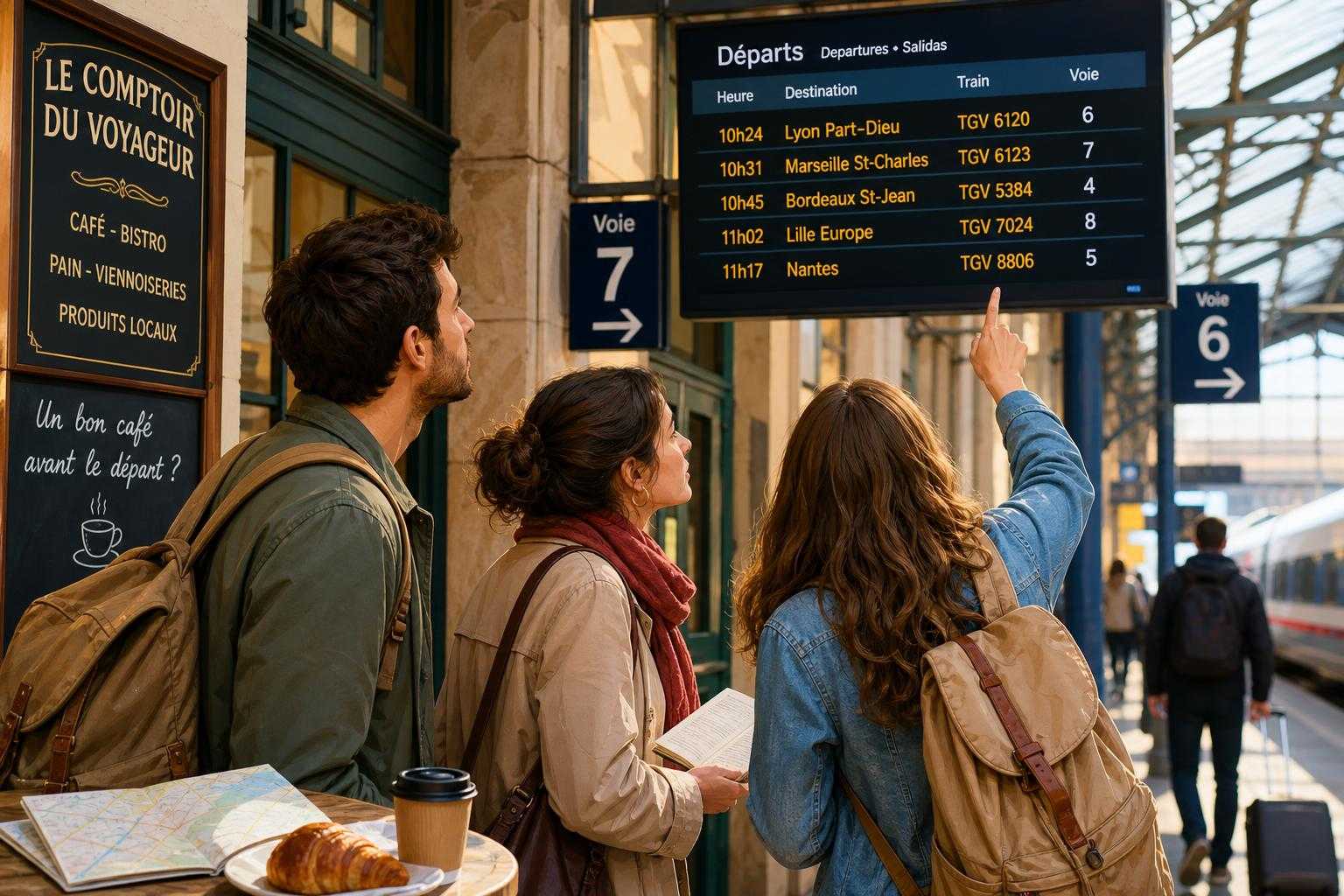
Train stations often announce delays, platform changes, boarding calls, and final departures. You do not need to catch every word. If you recognize a few key expressions, you can usually recover the important information.
| French phrase | English | What it means |
|---|---|---|
| Le train a du retard. | The train is delayed. | Your train is running late. |
| Le train est supprimé. | The train is cancelled. | The train is not running. |
| La voie a changé. | The platform/track has changed. | Check the board again. |
| Le départ est retardé de dix minutes. | Departure is delayed by ten minutes. | The train will leave later than planned. |
| Départ imminent. | Departure imminent / leaving soon. | The train is about to leave. |
| Terminus | Final stop | The train ends there. |
| Correspondance | Connection | You can change trains there. |
| Voie 4 | Platform/track 4 | Go to platform/track 4. |
A practical habit is to listen for the train number, the destination, and the platform number. If any of those three match your ticket, you are usually in the right place. If not, ask immediately instead of guessing.
How to ask for help when you feel confused
It is normal to feel uncertain in a busy station. These phrases are polite, natural, and easy to use when you need someone to slow down or repeat the information.
| French phrase | English |
|---|---|
| Excusez-moi, vous pouvez m’aider, s’il vous plaît ? | Excuse me, can you help me, please? |
| Je cherche mon train. | I am looking for my train. |
| Pouvez-vous répéter, s’il vous plaît ? | Could you repeat that, please? |
| Vous pouvez parler plus lentement, s’il vous plaît ? | Can you speak more slowly, please? |
| Je ne comprends pas. | I do not understand. |
| Je suis perdu / perdue. | I am lost. |
In French stations, a calm “Excusez-moi” goes a long way. It sounds polite and gives you a better chance of getting clear help.
What to say on the platform or in the carriage
Once you are on the platform, the goal is simple: confirm the right direction and stay aware of last-minute changes. These phrases are useful when you are checking whether you should board or wait.
| French phrase | English |
|---|---|
| Ce train va bien à Bordeaux ? | Does this train definitely go to Bordeaux? |
| Le train pour Marseille part d’ici ? | Does the train to Marseille leave from here? |
| Je suis dans la bonne voiture ? | Am I in the right carriage? |
| Où est la voiture 6 ? | Where is carriage 6? |
| Cette place est libre ? | Is this seat free? |
| La place est réservée ? | Is the seat reserved? |
| Je crois que c’est ma place. | I think this is my seat. |
| Pardon, je dois passer. | Sorry, I need to get through. |
On many long-distance trains in France, your ticket may include a carriage number and seat number. Look for voiture for carriage and place for seat.
If there is a delay, cancellation, or ticket problem
| French phrase | English |
|---|---|
| Mon train est supprimé. Qu’est-ce que je dois faire ? | My train is cancelled. What should I do? |
| Il y a un autre train ? | Is there another train? |
| Je vais rater ma correspondance. | I am going to miss my connection. |
| J’ai une correspondance à Lyon. | I have a connection in Lyon. |
| Je dois valider mon billet ? | Do I need to validate my ticket? |
| Où est la borne de validation ? | Where is the validation machine? |
| La machine ne marche pas. | The machine is not working. |
| Je n’arrive pas à ouvrir mon billet. | I cannot open my ticket. |
| Mon billet est sur mon téléphone. | My ticket is on my phone. |
| C’est ce train ? | Is it this train? |
| Je peux prendre ce train ? | Can I take this train? |
| Qu’est-ce que je dois faire ? | What should I do? |
A simple mini-dialogue you can copy
This is a realistic exchange you can adapt at the counter, on the platform, or near a help desk. The structure is simple, and that is exactly why it works.
| Speaker | French | English |
|---|---|---|
| Traveller | Bonjour, je cherche le train pour Nice. | Hello, I’m looking for the train to Nice. |
| Traveller | Il part de quelle voie ? | Which platform/track does it leave from? |
| Station staff | Voie 4. | Platform/track 4. |
| Traveller | Merci. | Thank you. |
| Station staff | De rien. | You’re welcome. |
You can swap in your destination, platform, or time of departure. If you remember the basic pattern, you can fill in the details in the moment.
Keep it simple, and you will get there
Train travel in French becomes much easier when you focus on a small set of high-value phrases: ask for the voie, confirm the train, check the destination, and ask for help politely if something changes.
You do not need perfect French to manage a train journey in France. Practice a few phrases out loud before your trip, especially the ones for asking the platform and confirming the train. Simple French is enough to get clear help and keep moving.