
Spanish for an Oaxacan Cooking Class: Ask, Follow, Taste
In an Oaxacan cooking class, the words you need change as the work moves from the ingredients to the chopping board, the heat and the tasting table. Introduce yourself, ask what a dish contains, check a direction before using a knife or stove, and ask the teacher to repeat a step when you miss it.
This guide follows the sequence described by Nora Andrea Valencia’s Alma de Mi Tierra class in Oaxaca City: a market visit, hands-on cooking and a meal together. Her school says a class runs in either Spanish or English, so choose the Spanish-language class if you want to practise these lines. The sample kitchen exchange below is for practice; it isn’t a transcript of Nora or her menu.
Seven lines to take into class
These are short, polite questions in Mexican Spanish. Puede uses the usted form when you ask the teacher for help; a classmate may invite a less formal tone. Keep the translation beside each line.
| Spanish | Meaning and moment |
|---|---|
| Buenas, soy Ana. Mucho gusto. | Hello, I’m Ana. Nice to meet you. Replace Ana with your name. |
| ¿Qué vamos a preparar hoy? | What are we going to make today? Ask at the start. |
| ¿Qué lleva esta salsa? | What’s in this sauce? Ask about the bowl in front of you. |
| ¿Me muestra cómo cortar la cebolla? | Could you show me how to cut the onion? Ask before picking up the knife. |
| ¿Así está bien? | Is this right? Check the result of a demonstrated step. |
| ¿A fuego bajo? | On low heat? Confirm a heat instruction before changing the stove. |
| Perdón, ¿me lo puede repetir más despacio? | Sorry, could you repeat that more slowly? Use when an instruction runs past you. |
Meet the cook and ask about the ingredients
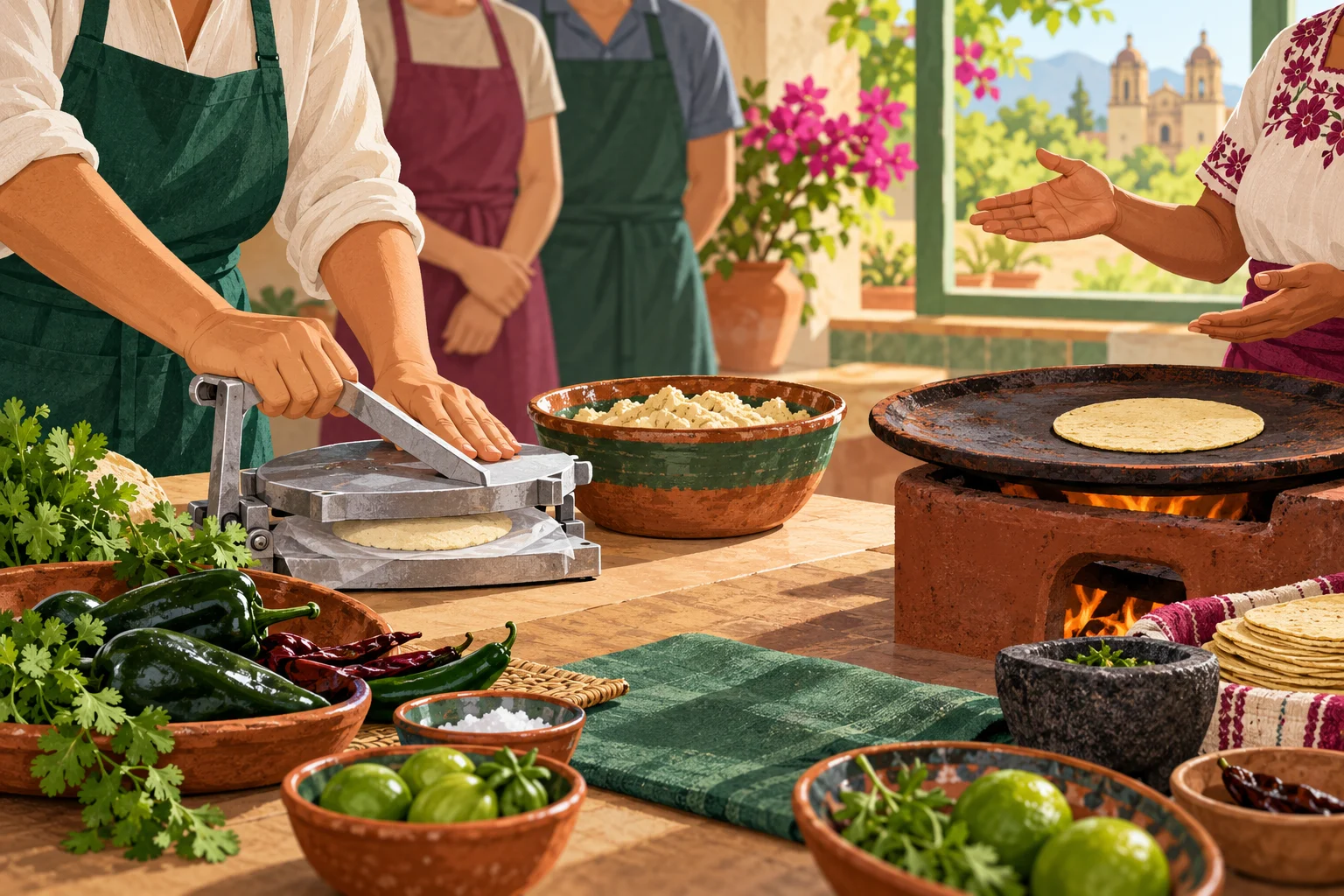
Nora introduces her own teaching as a visit to vendors followed by preparation in her Jalatlaco home kitchen. Let the cook name the day’s dishes and ingredients. “¿Qué vamos a preparar hoy?” opens that conversation; “¿Qué lleva esta salsa?” asks about one preparation without assuming every class makes the same sauce.
Oaxaca has many food traditions and languages. Mexico’s National Institute of Indigenous Languages documents the city’s multilingual life. These Spanish lines belong to this Spanish-language visitor class; they don’t describe every Oaxacan kitchen or replace a cook’s own explanation of their food.
Follow the knife and heat directions
Listen for “piquen” (“chop,” addressed to a group), “trozos pequeños” (“small pieces”) and “a fuego bajo” (“on low heat”). Mexican public-health recipes use picar and fuego bajo in kitchen instructions. If a direction isn’t clear, set the utensil down and ask “¿Me muestra cómo cortar la cebolla?” or “¿A fuego bajo?” Watch the demonstration and confirm before you act.
A teacher may point to a comal, the flat cooking surface used for tortillas and other foods; the Academia Mexicana de la Lengua records the term in Mexican Spanish. “¿Así está bien?” lets you check the thickness or shape you made. It’s a check on your work, not a request for the teacher to approve a guessed instruction.
Hear a reply, then keep going
The exchange below is an example with ordinary kitchen words. It doesn’t tell you what Nora prepares on a given day.
| In the class | English |
|---|---|
| You: Buenas, soy Ana. Mucho gusto. | Hello, I’m Ana. Nice to meet you. |
| Teacher: Mucho gusto. Hoy vamos a preparar una salsa. | Nice to meet you. Today we’re going to make a sauce. |
| You: ¿Qué lleva esta salsa? | What’s in this sauce? |
| Teacher: Chile, jitomate y cebolla. Piquen la cebolla. | Chile, red tomato and onion. Chop the onion. |
| You: Perdón, ¿me lo puede repetir más despacio? | Sorry, could you repeat that more slowly? |
| Teacher: Sí. Piquen la cebolla. | Yes. Chop the onion. |
| You: ¿Así está bien? | Is this right? |
If the answer is “Sí, así está bien” (“Yes, that’s right”), continue with the next shown step. If you hear “Un poco más pequeño” (“A little smaller”), ask the teacher to show the size. During tasting, “¿Ya podemos probar?” asks whether the group can taste it yet. Wait for the cook’s answer, especially while food or cookware is hot.
Say it clearly and keep one fallback ready
In Mexican Spanish, stress co-MAL on the last syllable, pi-CAR on the last, and des-PA-cio in the middle. The written hints help you remember the stress; listen to a local speaker for the sounds. There’s no inline audio here because a Mexican Spanish voice and its output haven’t been checked by ear.
Before class, practise your introduction, “¿Qué lleva esta salsa?” and the repeat request aloud. For general greetings outside the kitchen, the Spanish travel phrase guide has more examples; its existing audio uses a Colombian voice, so it isn’t a recording of Oaxacan speech.