Spanish for a Guided Hike to Poq Poq Near Cusco
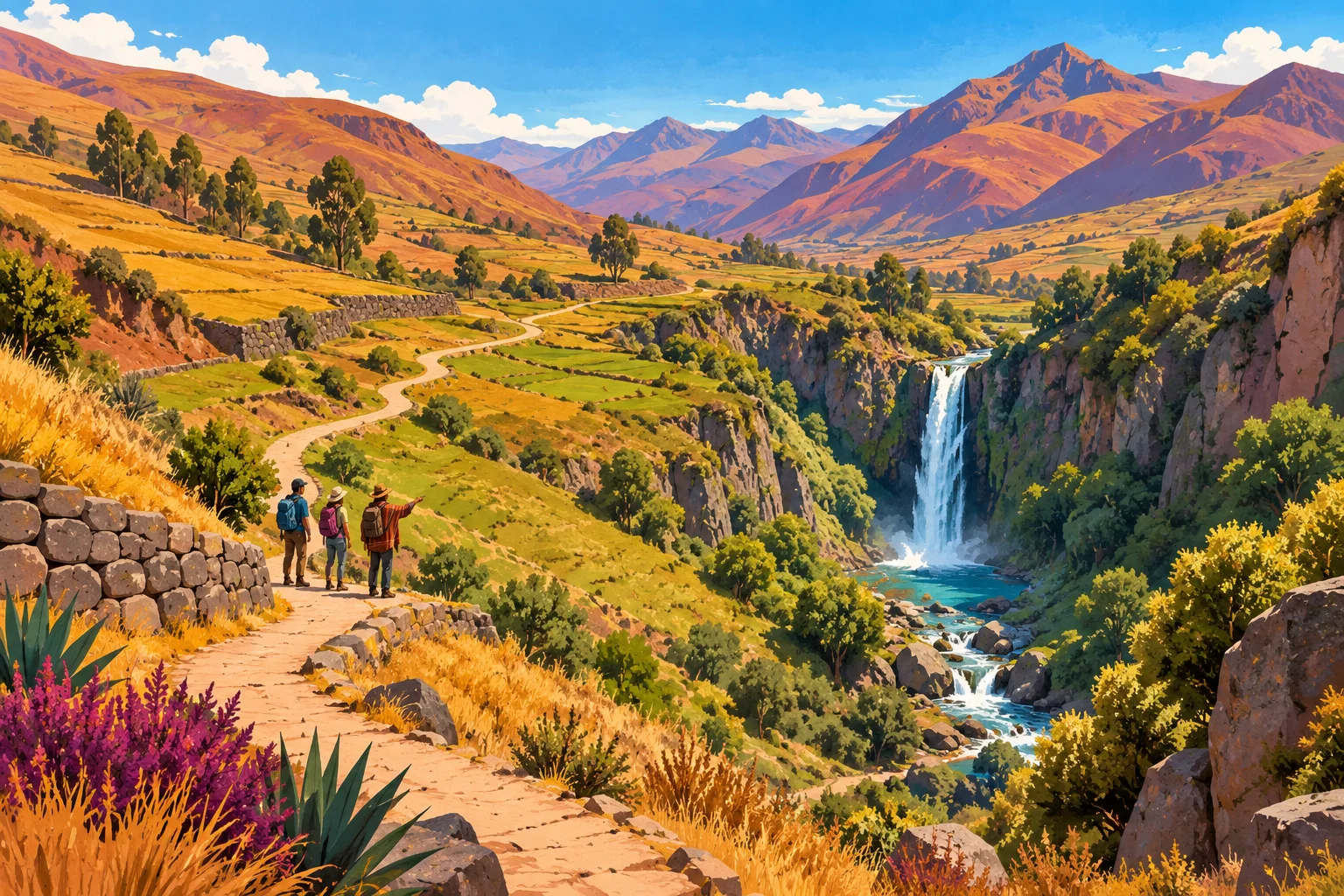
Before a guided walk from Chinchero toward the Poq Poq waterfall near Cusco, ask where the path starts and how far you’ll walk. Once you’re moving, tell your guide when you need a slower pace or a break. These short Spanish lines help you do both without pretending a phrase card can make a route safe.
The example follows a walk to the waterfall, whose name also appears as Poc Poc in visitor material. It doesn’t describe a booked tour or promise that a particular path will be open. Confirm your guide’s route, conditions, water plan and return transport before setting out.
Six lines to take on the walk
Use these with a Spanish-speaking guide in the Cusco region. Podemos asks whether the group can do something; necesito tells the guide what you need now. Don’t wait for the guide to guess that you’ve fallen behind.
| Spanish | Meaning and moment |
|---|---|
| ¿Dónde empieza la caminata? | Where does the walk start? Ask before you leave Chinchero. |
| ¿Cuánto falta para la catarata? | How much farther to the waterfall? |
| ¿Podemos ir más despacio? | Can we go more slowly? |
| Necesito descansar un momento. | I need to rest for a moment. Say it before you’re exhausted. |
| ¿Tenemos suficiente agua para la vuelta? | Do we have enough water for the return? |
| ¿Volvemos por el mismo camino? | Are we returning by the same path? |
For pronunciation, stress ca-mi-NA-ta, ca-ta-RA-ta and des-PA-cio. The written stress cues aren’t local audio. This page has no inline recording because a Cusco Spanish voice and its playback haven’t been checked by ear.
Agree on the start and the route
Peru’s tourism inventory places the Poq Poq waterfall about 3.5 km (2.2 miles) on foot from Chinchero. PROMPERÚ’s visitor guide describes roughly 4 km (2.5 miles) from Chinchero Archaeological Park. Those descriptions name different starting points. Ask ¿Dónde empieza la caminata? and have the guide show you the route, including the way back.
The Peruvian mountain research institute’s ecotourism guide also describes a longer 8.3 km (5.2 mile) Chinchero–Poc Poc–Cúper Ccasa route. A waterfall visit and that longer route aren’t the same commitment. Ask ¿Vamos solo hasta la catarata o seguimos hasta Cúper Ccasa? — “Are we going only to the waterfall, or continuing to Cúper Ccasa?” Confirm whether the quoted distance is one way or the whole walk.
Ask ¿Cómo está el sendero hoy? — “How’s the path today?” A guide may answer Está resbaloso. (“It’s slippery”) or point to a section you should avoid. Check SENAMHI’s Cusco forecast before travelling, then follow the guide’s current assessment on the ground. An old route description can’t tell you today’s footing.
Set the pace and ask for a pause
If the group moves too fast, ask ¿Podemos ir más despacio? If you need to stop, say Necesito descansar un momento. The first request concerns the group’s pace; the second makes your own need clear. A guide may reply Sí, descansamos aquí. — “Yes, we’ll rest here.” Point to a safe stopping place if you can’t catch every word.
Keep water and the return in the conversation. ¿Tenemos suficiente agua para la vuelta? asks about the whole outing, not just the walk to the falls. ¿Volvemos por el mismo camino? checks whether you’ll retrace the path or meet transport elsewhere. Let the guide answer before you plan around either option.
At altitude, say when you need to stop
The tourism inventory puts the waterfall at about 3,418 m (11,214 ft). The CDC’s high-altitude guidance says a recent ascent can bring headache with nausea, dizziness or fatigue, and worsening symptoms need prompt attention and descent. Don’t treat this article as medical advice or push on because the group has a destination. If you feel unwell, tell your guide No me siento bien. Necesito parar. — “I don’t feel well. I need to stop.” Ask for qualified medical help and follow the guide’s safety plan. People with relevant medical conditions should seek travel-medicine advice before the trip.
Spanish can help with a guide who chooses to use it, but it isn’t the region’s only language. Peru’s Ministry of Culture documents Quechua varieties in Cusco. Ask your guide which language works for them. This card teaches Spanish only; it doesn’t turn Quechua place names into an unreviewed phrase list.
Practise both sides before departure
This is an example exchange, not a report of a particular guide or a forecast for your day. Its route and water answers must come from the person leading your walk.
| On the walk | English |
|---|---|
| You: ¿Vamos solo hasta la catarata? | Are we going only to the waterfall? |
| Guide: Sí. Después volvemos a Chinchero. | Yes. Afterwards we return to Chinchero. |
| You: ¿Cuánto falta? | How much farther? |
| Guide: Falta un poco. ¿Necesitas descansar? | A little farther. Do you need to rest? |
| You: Sí, necesito descansar un momento. | Yes, I need to rest for a moment. |
| Guide: Claro. Descansamos aquí. | Of course. We’ll rest here. |
If you miss the answer, say Perdón, ¿me lo puede repetir más despacio? — “Sorry, could you repeat that more slowly?” The Instituto Cervantes’ beginner curriculum models a slower-speech request. Here puede gives you a courteous form for a guide you’ve just met.
Practise the pace and rest lines aloud before you meet the group. A Cusco-area Spanish speaker and local guide haven’t yet reviewed the full exchange, so check any wording you plan to depend on with your guide. For greetings and another repeat request, see our Spanish travel phrases guide; its Colombian audio isn’t a recording of Cusco Spanish.