Japanese for a Pottery Workshop in Kyoto
At a Kyoto pottery workshop, you shape the clay now and receive the fired piece later. Learn the Japanese to confirm your booking, ask the instructor to repeat a hand movement, check your shape, and settle delivery before you leave.
These polite, standard Japanese lines follow a wheel session at Zuikou’s Kyoto-Kiyomizu studio. The studio says this location offers instruction in English; its Higashiyama studio offers lessons only in Japanese. Use the phrases to take part, and use the language support available when a technique or delivery detail needs a full explanation.
Five lines for the class
Keep the Japanese and its meaning together on your phone. Point to the clay or booking page when the subject of a question isn’t clear.
| Japanese and pronunciation | What it does |
|---|---|
| 予約したいんですけど。 Yoyaku shitai n desu kedo. | I’d like to make a booking. Opens an enquiry. |
| もう一度見せてください。 Mō ichido misete kudasai. | Please show me again. Use after a missed demonstration. |
| これでいいですか。 Kore de ii desu ka? | Is this okay? Show your clay piece as you ask. |
| 作品はいつ頃届きますか。 Sakuhin wa itsugoro todokimasu ka? | About when will the finished piece arrive? |
| もういちど、ゆっくり説明してください。 Mō ichido, yukkuri setsumei shite kudasai. | Please explain it again slowly. |
The bar over ō in mō marks a long vowel: hold it longer than a short o. Romanization helps you start reading, but it doesn’t supply the pace or pitch of a spoken exchange. This article has no inline audio because a suitable Japanese voice and its output haven’t been checked by ear.
Book the right studio and session
Zuikou’s English information page lists a Light Plan for a small cup, a Standard Plan with a wider choice of shape, and a longer two-piece plan. As checked on 18 October 2026, the Standard Plan lists 25 minutes: about 20 minutes at the wheel and five minutes to choose a finish and enter an address. Follow the studio’s reservation link for your date, price, and party size; don’t assume the longer plan has the same time or number of pieces.
If you enquire by phone or message, 予約したいんですけど。 opens the conversation without pretending you know the available times. The Japan Foundation’s booking dialogue uses the same opening and then confirms date, time, number of people, name, and contact number. Keep those details written down so you can check the reply.
At the wheel: clay, shape, and a missed movement
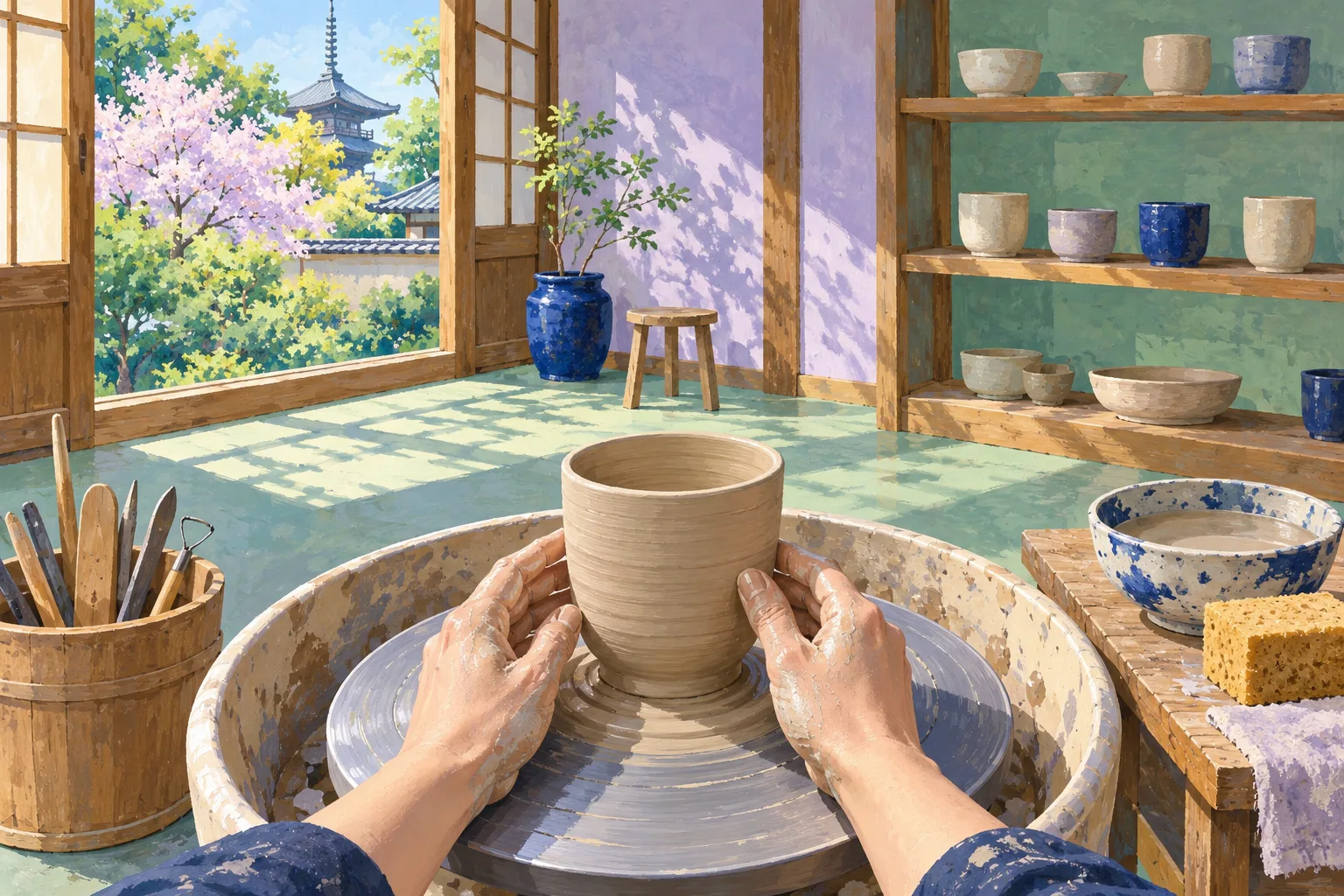
The studio’s published class sequence starts with clay on an electric wheel, 電動ろくろ dendō rokuro. It calls the clay 土 tsuchi and the vessel’s shape 形 katachi. The instructor guides the shaping; you choose a glaze colour after the form is ready. 釉薬 yūyaku is the glaze, not a clay colour you mix into the wet cup.
Watch where the instructor puts their fingers before you press on the spinning clay. If your view was blocked, say もう一度見せてください。 An official practical-demonstration dialogue uses this exact request. It asks for another demonstration rather than a longer verbal explanation. Then show your piece and ask これでいいですか。 The Japan Foundation uses that short check when someone asks whether their work is right.
A two-way practice exchange
This is a practice exchange, not a transcript of a Zuikou lesson. The instructor may use different words or show the next move with their hands.
- You: すみません。もう一度見せてください。 Sumimasen. Mō ichido misete kudasai. — Sorry. Please show me again.
- Instructor: はい。 Hai. — Yes. The instructor repeats the movement.
- You: これでいいですか。 Kore de ii desu ka? — Is this okay?
- Instructor: はい、大丈夫です。 Hai, daijōbu desu. — Yes, that’s fine.
If words still run ahead of you, say もういちど、ゆっくり説明してください。 The Japan Foundation’s request exercise gives that slower-explanation line. Point to the part of the cup you mean while you ask.
Firing and getting your piece
You choose the glaze in class; the studio’s craftspeople finish and fire the work afterward. The studio calls firing 焼成 shōsei and says it sends finished pieces by post. Its English page estimates around seven to ten weeks for overseas delivery, with customs able to change that time. The page gives an arrival window, not a separate kiln date; ask staff for the firing schedule if you need it. Ask 作品はいつ頃届きますか。 before giving an address; the studio uses that exact question in its Japanese FAQ.
Show the full delivery address on your phone and have staff confirm the country and postal code. The studio lists shipping as an extra charge and names countries it currently can’t ship to. Check its live list before booking. The published process describes postal delivery, so if you need to collect your piece in Kyoto, ask the studio about that possibility first; the page doesn’t promise collection.
Practise the repeat request and the arrival question together before class. If you want another Kyoto activity where you watch a teacher and ask to try a tool, see the Kyoto tea workshop Japanese guide.
Sources and language check
Workshop details: Zuikou’s English course page and Japanese process and FAQ. Booking and request patterns: the Japan Foundation’s booking lesson and request exercise. A Kyoto Japanese speaker review of the complete practice exchange and checked inline audio remain pending; the guide gives Japanese script and romanization so readers can show the exact question to staff.