
How to Sound Polite in Italian Without Learning Full Grammar
If you want to sound polite in Italian fast, you do not need to master every verb ending. A few simple words, a softer tone, and the right habits can make your Italian feel much more natural in shops, cafés, and everyday conversation.
Start with the polite basics
The easiest politeness markers are small words you can add almost anywhere. They do a lot of work without requiring grammar practice.
- Per favore = please. Use it when asking for something: “Un caffè, per favore.”
- Grazie = thank you. You will use this constantly.
- Prego = you’re welcome / go ahead / here you are. It is one of the most useful words in Italian.
- Scusi = excuse me / sorry. This is a safe, polite opener with strangers.
- Mi scusi = excuse me, more polite and slightly more formal.
Use softeners to make requests feel lighter
Italian often sounds more polite when you soften a request instead of making it feel too direct. You do not need fancy grammar for this; you just need a few starter phrases.
| English idea | Simple Italian | When to use it |
|---|---|---|
| Can I have…? | Posso avere…? | Ordering food or drinks |
| Could I get…? | Vorrei… | Polite shopping and cafés |
| May I ask…? | Posso chiedere…? | When starting a question |
| Excuse me, where is…? | Scusi, dov’è…? | Asking strangers for directions |
If you only memorize one pattern, make it “Vorrei…”. It literally means “I would like…”, and it sounds polite in almost any casual service situation.
For more ready-to-use everyday phrases, you may also like this guide to Italian Everyday Expressions to Sound Local
In shops and cafés, keep the sentence short and friendly

In Italy, polite does not have to mean long. A short phrase plus a friendly “grazie” is usually enough.
- Un cappuccino, per favore. — A cappuccino, please.
- Vorrei un panino. — I’d like a sandwich.
- Scusi, il conto, per favore. — Excuse me, the bill, please.
- Grazie mille. — Thanks a lot.
- Va bene, grazie. — That’s fine, thank you.
A useful habit: when you place an order, begin with the item instead of a full explanation. Italian service interactions are usually quick, so simple and direct is still polite when you add “per favore” or “vorrei”.
When speaking to strangers, choose the safer form
If you are unsure whether to use a formal or informal tone, start with the safer choice. With strangers, staff, older people, and anyone helping you, “Scusi” is a good default.
You do not need to overthink this. In everyday travel situations, a polite opener, a short request, and a thank you will carry most of the conversation.
- Scusi, può aiutarmi? — Excuse me, can you help me?
- Scusi, dov’è la stazione? — Excuse me, where is the station?
- Mi scusi, non capisco. — Excuse me, I do not understand.
- Sì, grazie. — Yes, thank you.
- No, grazie. — No, thank you.
A few habits matter as much as the words
Politeness in Italian is not only about vocabulary. Tone, timing, and small follow-up words make a big difference.
- Start with a greeting before asking for something. A simple buongiorno or buonasera makes the whole sentence feel warmer.
- Do not launch straight into the request when speaking to a stranger. Instead of just saying un caffè, say:
- Buongiorno, un caffè, per favore.
- Good morning, a coffee, please.
- Add grazie after help, service, or answers. Even a quick grazie mille — thank you very much — is useful.
- Use a gentle tone instead of sounding rushed. Italian can sound direct, but in real life, your tone does a lot of the politeness work.
- Use scusi or mi scusi when getting someone’s attention, interrupting, or asking a stranger for help.
- If you need to repeat yourself, keep it calm and simple:
- Scusi, non capisco.
- Sorry, I do not understand.
You do not need to overdo it. A greeting, per favore, grazie, and a calm tone will already make you sound much more polite.
If you want a bigger set of practical phrases for getting around, this post is a helpful next step: Italian Phrases for Everyday Travel and Survival
Use this simple formula anywhere
A simple polite pattern you can use anywhere
When you are not sure what to say, use this simple pattern:
Greeting + polite opener + request + thank you
That is enough for most beginner situations. You do not need a perfect sentence. A short, kind sentence usually works better than a complicated one that feels forced.
Here is the pattern broken down:
| Part | Italian | English |
|---|---|---|
| Greeting | Buongiorno | Good morning / good day |
| Polite opener | Vorrei… | I would like… |
| Request | un caffè / un tavolo / questo | a coffee / a table / this |
| Polite ending | per favore | please |
| Thanks | Grazie | thank you |
You can put it together like this:
Buongiorno, vorrei un caffè, per favore. Grazie.
Good morning, I would like a coffee, please. Thank you.
The same structure works in many everyday situations:
| Situation | Italian | English |
|---|---|---|
| Ordering coffee | Buongiorno, vorrei un caffè, per favore. Grazie. | Good morning, I would like a coffee, please. Thank you. |
| Asking for a table | Buonasera, vorrei un tavolo per due, per favore. Grazie. | Good evening, I would like a table for two, please. Thank you. |
| Buying something | Buongiorno, vorrei questo, per favore. Grazie. | Good morning, I would like this, please. Thank you. |
| Asking for help | Buongiorno, vorrei un’informazione, per favore. Grazie. | Good morning, I would like some information, please. Thank you. |
The goal is not to sound fluent. The goal is to sound calm, respectful, and easy to help.
Practice the few phrases you will actually use
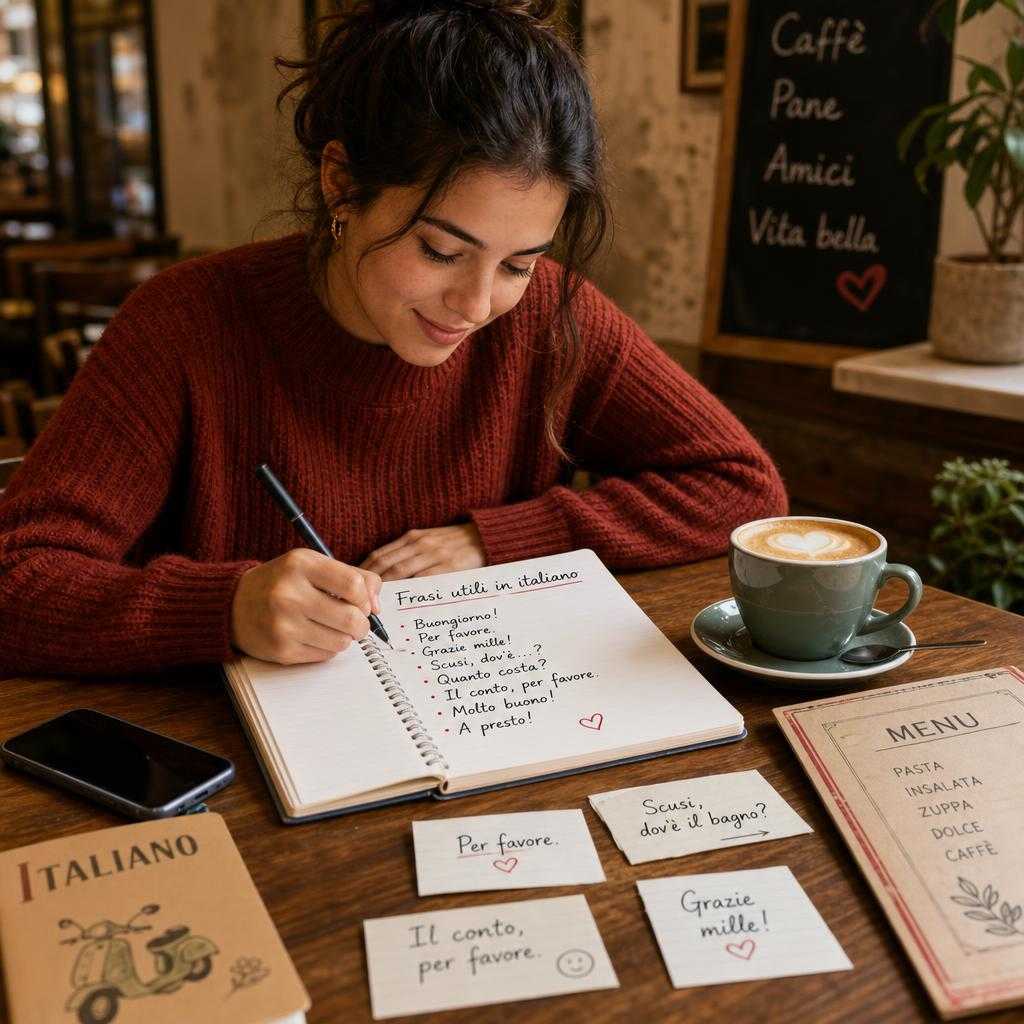
Start with the polite words you will use most
You do not need to learn all of Italian politeness at once. Start with the words and phrases you will say most often, and let those become automatic.
| Italian | English | When to use it |
|---|---|---|
| Per favore | Please | When asking for something. |
| Grazie | Thank you | After someone helps you, serves you, or gives you something. |
| Prego | You’re welcome / go ahead | As a reply to grazie, or when inviting someone to go first. |
| Scusi | Excuse me / sorry | To get someone’s attention politely, especially someone you do not know. |
| Vorrei… | I would like… | A polite way to ask for something. |
| Mi scusi | Excuse me / I’m sorry | A slightly fuller version of scusi. Useful when interrupting or apologising. |
Once these phrases feel easy, you will sound more polite, more confident, and much more comfortable in everyday Italian. That is the real goal: not perfect grammar, but clear and respectful communication.