French for Geneva Trams and Lake Boats: Stops, Tickets, and Departures
In Geneva, check the tram’s direction before you board and the lake boat’s destination before you walk onto the quay. A short French question can settle either choice: “Ce tram va vers Cornavin ?” (“Does this tram go towards Cornavin?”) or “C’est bien la Mouette pour le Molard ?” (“Is this the Mouette boat for Molard?”).
This guide uses everyday French for a Geneva stop and one of the city’s short public lake crossings. Read the live display or timetable as well as asking: routes and departure times can change. The examples don’t assume that every person in multilingual Switzerland speaks French.
Six lines to keep on your phone
Use vous with a staff member or a stranger. The questions are brief enough to say while people are boarding, and each asks for one piece of information.
| French | Meaning and moment |
|---|---|
| Bonjour, excusez-moi. | Hello, excuse me. Open a question. |
| Ce tram va vers Cornavin ? | Does this tram go towards Cornavin? Check direction. |
| C’est bien la Mouette pour le Molard ? | Is this the Mouette for Molard? Check the boat. |
| À quelle heure est le prochain départ ? | What time is the next departure? |
| Ce billet est valable pour la Mouette ? | Is this ticket valid for the Mouette? |
| Pardon, vous pouvez répéter plus lentement ? | Sorry, can you repeat more slowly? |
At the tram stop: line, direction, then stop
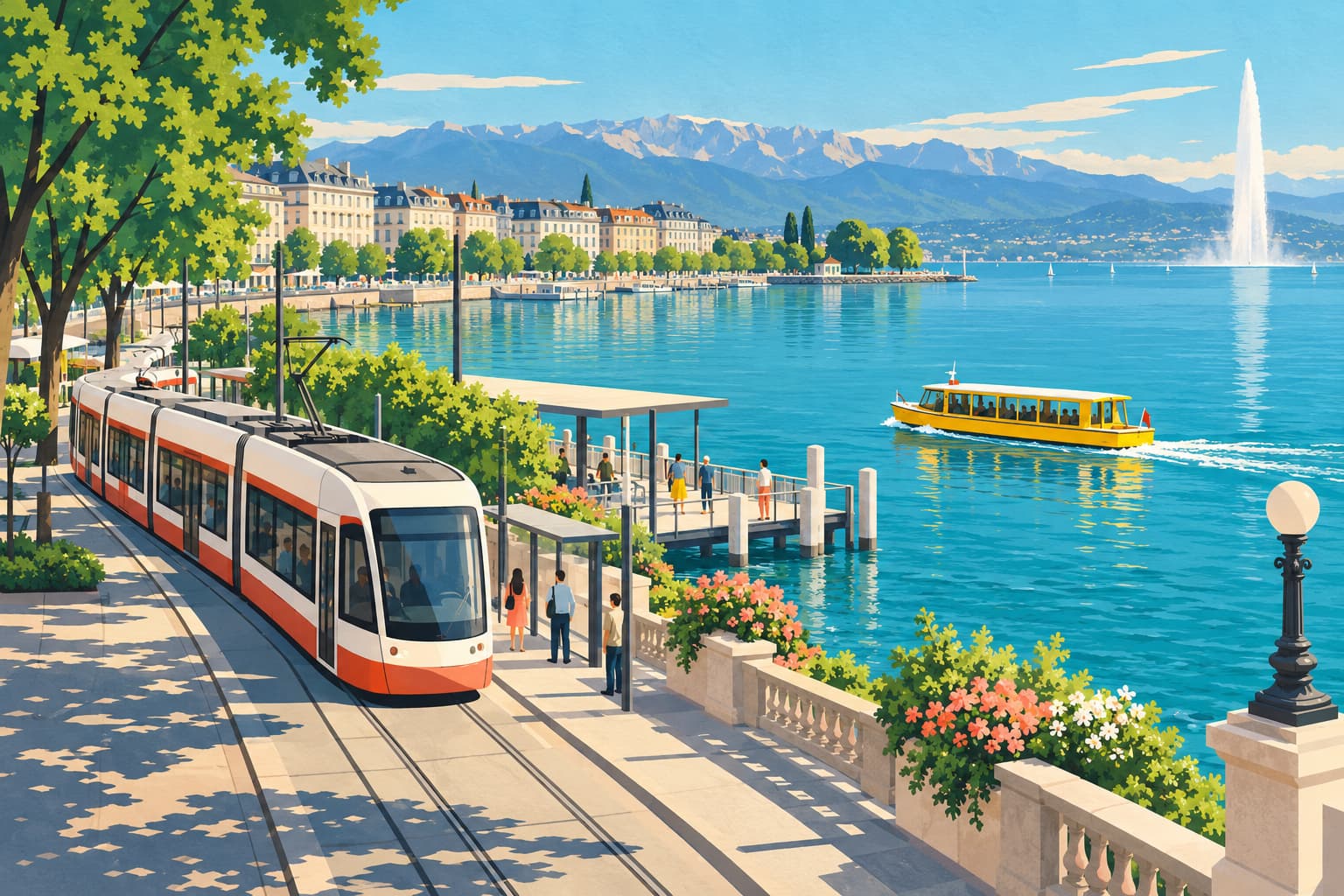
The operator tpg says its stop information shows the stop name, lines, destinations, timetables, and next departures. Look at the destination as well as the line number: a line runs in two directions. Ask “Ce tram va vers Cornavin ?” if you’re trying to reach Geneva’s Cornavin station. Replace Cornavin with the stop or destination you need.
A reply such as “Oui, mais c’est de l’autre côté” means “Yes, but it’s on the other side.” That tells you to check the opposite platform before boarding. If someone says “Non, prenez le suivant” (“No, take the next one”), look again at the display; don’t treat the first tram you see as yours.
Once aboard, “Quel est le prochain arrêt ?” asks “What’s the next stop?” The written word arrêt can mean a stop, while direction on a display points to where that service is heading. The tpg line and stop pages let you check the current route and timetable before you travel.
At the lake: find the right Mouette
The Mouettes genevoises are public shuttle boats across Geneva’s lakefront, not a general ticket for a sightseeing cruise. Unireso lists the M1 crossing between Pâquis and Molard and the M2 between Pâquis and Eaux-Vives. At Pâquis, “C’est bien la M1 pour le Molard ?” checks both the line and the landing you want. Look for the marked embarkation point before you join a queue.
For the next boat, ask “À quelle heure est le prochain départ pour le Molard ?” (“What time is the next departure for Molard?”). Someone might answer “Dans dix minutes” (“In ten minutes”). That’s a practice reply, not today’s schedule. The tpg app’s route planner includes Mouettes and current departures; check it or the operator’s timetable on the day.
Ask which ticket covers your trip
Within Geneva’s zone 10, tpg lists a 60-minute Tout Genève ticket and a shorter saut de puce ticket. A valid Tout Genève ticket covers tpg trams and Mouettes within its time and zone. The saut de puce covers up to three stops on one tpg line or a single Mouette crossing; it isn’t a tram-to-boat transfer ticket. Check the ticket you actually hold before boarding.
If you’re unsure at a sales point, show the ticket and ask “Je peux prendre le tram et la Mouette avec ce billet ?” (“Can I take the tram and the Mouette with this ticket?”). A staff member may answer “Oui, c’est un billet Tout Genève” (“Yes, it’s a Tout Genève ticket”) or tell you that your saut de puce only covers one leg. Buy the right ticket before travel; ticket rules and prices should be checked again when you go.
A two-way practice exchange
This sample moves from a ticket question to the M1 landing at Pâquis. It shows possible replies, not a promise about a particular departure.
| French exchange | English |
|---|---|
| You: Bonjour. Je peux prendre la Mouette avec ce billet Tout Genève ? | Hello. Can I take the Mouette with this Tout Genève ticket? |
| Staff: Oui, s’il est encore valable. | Yes, if it’s still valid. |
| You: Merci. C’est bien la M1 pour le Molard ? | Thanks. Is this the M1 for Molard? |
| Staff: Oui. Le départ est de ce côté. | Yes. The departure is on this side. |
| You: Pardon, vous pouvez répéter plus lentement ? | Sorry, can you repeat more slowly? |
| Staff: De ce côté. | On this side. |
| You: Merci beaucoup. | Thank you very much. |
Hear the place name and practise the repair line
In Mouette, the final t is audible: roughly mwet. In billet, the final t is silent: roughly bee-yay. Those English hints don’t replace a Geneva French speaker’s pronunciation. No inline audio appears here because a Swiss French voice and its output haven’t been checked by ear.
Geneva’s cantonal constitution names French as its official language, while Switzerland has several national languages and Geneva residents also use other languages. A French question is a sensible start, not a claim about the person beside you. Practise the direction question and “Pardon, vous pouvez répéter plus lentement ?” together. For more greetings and repair phrases, use the French travel phrase guide.