French at an Abidjan Market: Asking About Cloth and Prices
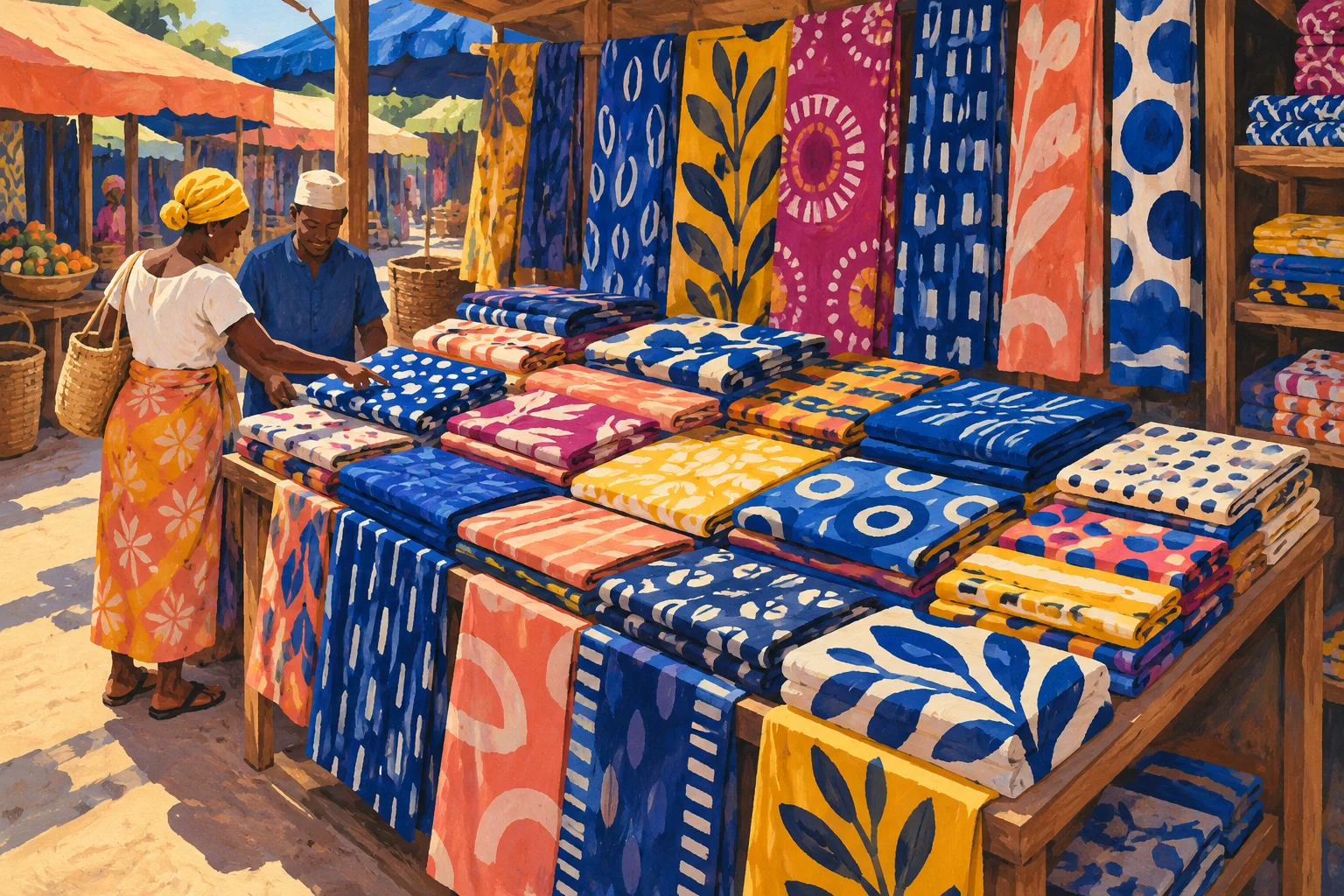
At a cloth stall in Abidjan, start by pointing to one fabric, then check its length and price before you buy. Bonjour. Je peux voir ce tissu, s’il vous plaît ? means “Hello. May I see this fabric, please?” The exchange below uses clear, polite French that a beginner can say. It doesn’t claim to reproduce every way people speak in Abidjan.
The Ivorian government lists the Grand Marché de Treichville as an operating market, and local reporting has documented cloth sellers there. This is a practice scene, not a promise that a particular stall or fabric will be there when you visit.
The first four lines
Use vous with a seller you’ve just met. Point to one piece so ce tissu (“this fabric”) has a clear referent.
| Say | Meaning |
|---|---|
| Bonjour. Je peux voir ce tissu, s’il vous plaît ? | Hello. May I see this fabric, please? |
| Quelle longueur fait cette coupe ? | How long is this cut piece? |
| Ça coûte combien ? | How much does it cost? |
| Le prix est pour la coupe entière ? | Is that the price for the whole cut piece? |
Check what you’re buying
Tissu means fabric. At a cloth stall you may also hear pagne, a word used for cloth and for a garment made from it. Ask the seller what a particular piece is called rather than assuming that every print has the same material or origin. C’est du coton ? asks “Is it cotton?” Vous avez ce motif dans une autre couleur ? asks “Do you have this pattern in another colour?”
Length needs its own question. Ivorian cloth maker Uniwax lists one printed cotton product in cuts of two, four, or six yards; that doesn’t tell you how a market seller prices another piece. A two-yard cut is about 1.8 m (2 yd) long. After Quelle longueur fait cette coupe ?, you may hear a length in yards or metres. If it isn’t what you need, say Il me faut une coupe plus longue. (“I need a longer cut piece.”) Check the width too if you’re buying fabric for a particular sewing project: Quelle est la largeur ? (“What’s the width?”)
Confirm the price and payment
Ça coûte combien ? is an ordinary spoken price question; TV5MONDE teaches the same wording. A quoted amount may apply to one cut, a length, or several pieces, so confirm what it covers before agreeing. The sample amount below is for practice, not a current market price.
Ask Vous acceptez quel moyen de paiement ? (“What payment method do you accept?”) and follow the seller’s answer. Don’t assume a card, cash, or a phone payment will work at every stall. If you don’t want to buy, Merci, je vais réfléchir. (“Thanks, I’ll think about it.”) lets you leave without starting a price negotiation. If you do want to ask whether the quoted amount can change, Le prix est fixe ? (“Is the price fixed?”) asks the question without treating bargaining as a rule.
A short exchange at the stall
You: Bonjour. Je peux voir ce tissu, s’il vous plaît ? Hello. May I see this fabric, please?
Seller: Oui, bien sûr. Yes, of course.
You: Quelle longueur fait cette coupe ? How long is this cut piece?
Seller: Deux yards. Two yards.
You: Ça coûte combien ? Le prix est pour la coupe entière ? How much is it? Is that for the whole cut piece?
Seller: Six mille francs pour la coupe. Six thousand francs for the cut piece.
You: D’accord. Vous acceptez quel moyen de paiement ? Okay. What payment method do you accept?
Seller: En espèces. Cash.
You: Merci. Je la prends. Thanks. I’ll take it.
Here la refers to la coupe, the cut piece. If the seller quotes a different length or price, pause and check the number rather than repeating this script.
If you miss the answer
Say Je n’ai pas bien compris. Vous pouvez répéter plus lentement, s’il vous plaît ? (“I didn’t quite understand. Could you repeat more slowly, please?”) For a price, add Vous pouvez me montrer le montant ? (“Could you show me the amount?”) A written number on a calculator or phone can help you confirm it before paying.
For approximate pronunciation, pagne has one syllable, /paɲ/; its gn is close to the ny in “canyon,” without a hard g. Coupe is /kup/, close to “koop.” These are rough cues, not recordings of Abidjan French. This guide has no inline audio because a Côte d’Ivoire French voice and its playback haven’t been checked. You can practise the price question with TV5MONDE’s recording, while remembering that it isn’t a model of every Abidjan voice.
French is one language you may hear
French is Côte d’Ivoire’s official language, but Abidjan is multilingual. Research published by the Organisation internationale de la Francophonie describes Dioula in markets alongside French and other languages. It also describes local forms of French, including Nouchi. The lines here stay with broadly understood French; they don’t ask a newcomer to imitate speech they haven’t learned from local speakers. If someone uses another language, follow their lead and ask politely what works for the exchange.
Before you go, practise the sequence aloud: ask to see the cloth, check its length, confirm the price, then ask how to pay. For more first-contact phrases beyond this stall, see our French survival phrases guide.