
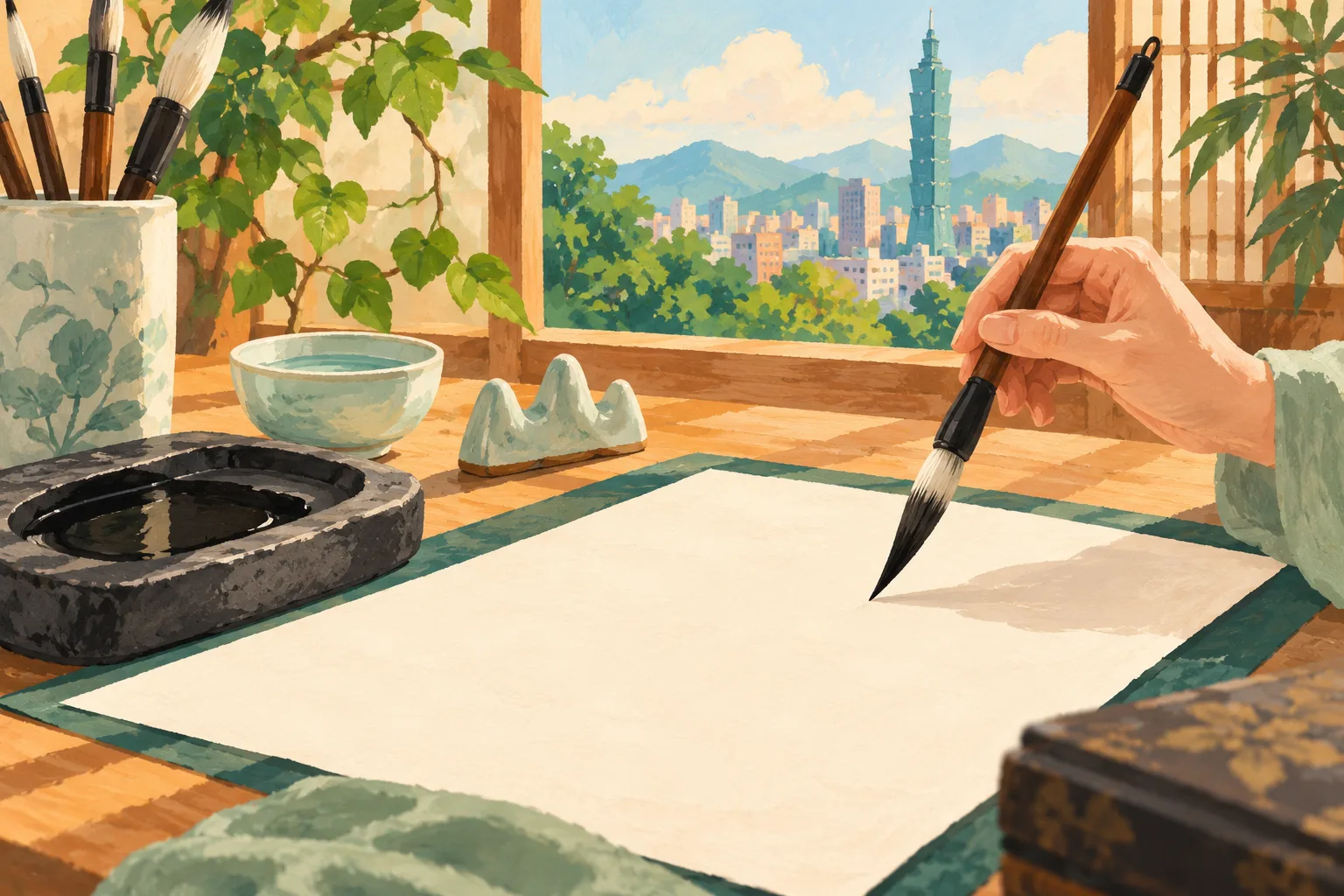
Mandarin for a Calligraphy Class in Taipei
You can join a Taipei calligraphy class without speaking Mandarin. A few Taiwan Mandarin phrases still help when you want to ask about the brush, follow a stroke demonstration, or check whether you may photograph someone else’s work.
This guide uses traditional characters and tone-marked pinyin. The examples suit a beginner speaking to an instructor or another participant; ask the instructor which language they’ll use before you book.
Five phrases to take to the table
Keep the question on your phone and point to the tool or stroke as you speak. The English sits beside each Mandarin line so you can check what you’re asking.
| Taiwan Mandarin | Meaning |
|---|---|
| 我是第一次寫書法。 Wǒ shì dì yí cì xiě shūfǎ. | It’s my first time doing calligraphy. |
| 這是毛筆嗎? Zhè shì máobǐ ma? | Is this the calligraphy brush? |
| 這一筆怎麼寫? Zhè yì bǐ zěnme xiě? | How do I write this stroke? |
| 可以再示範一次嗎? Kěyǐ zài shìfàn yí cì ma? | Could you show me again? |
| 我可以拍您的作品嗎? Wǒ kěyǐ pāi nín de zuòpǐn ma? | May I photograph your work? |
Know the tools before you start
At a calligraphy workshop in Ximending, beginners practise brush movements and basic strokes with an instructor. The studio says it provides brushes, ink, and paper, and Mandarin isn’t required. Its page lists a 1.5-hour session for up to five people; check the current details with the studio when you enquire.
毛筆 máobǐ is the brush; 墨 mò is ink; 筆畫 bǐhuà is a written stroke. The Taiwan Ministry of Education’s dictionary defines máobǐ as a brush used for writing or painting, and its entry for 筆畫 describes the marks that make up a character. These are words you can use while looking at the tools in front of you.
To ask how much ink to use, point to the brush and ask 要用多少墨? Yào yòng duōshǎo mò? (“How much ink should I use?”). Then watch the instructor’s answer instead of guessing how deep to dip the brush.
Ask about a stroke, then check the answer
When you point to one mark, 這一筆 zhè yì bǐ means “this stroke.” It helps the instructor see exactly where you’re stuck. If you mean the order of several marks, ask 筆順是什麼? Bǐshùn shì shénme? (“What’s the stroke order?”). The education ministry defines 筆順 as the order in which you write a character’s strokes.
After the instructor demonstrates, hold up your practice sheet and ask 這樣可以嗎? Zhèyàng kěyǐ ma? (“Is it okay like this?”). If you missed the movement, 可以再示範一次嗎? asks for another demonstration without claiming you understood the first one.
A short two-way exchange
This is a practice exchange, not a transcript from a particular class. The instructor’s reply gives you something to listen for while you watch their hand.
- You: 這一筆怎麼寫? Zhè yì bǐ zěnme xiě? — How do I write this stroke?
- Instructor: 我示範一次。 Wǒ shìfàn yí cì. — I’ll show you once.
- You: 可以再示範一次嗎? Kěyǐ zài shìfàn yí cì ma? — Could you show me again?
- Instructor: 可以。 Kěyǐ. — Sure.
- You: 謝謝,這樣可以嗎? Xièxie, zhèyàng kěyǐ ma? — Thanks. Is it okay like this?
If an explanation goes too fast, say 不好意思,可以說慢一點嗎? Bù hǎoyìsi, kěyǐ shuō màn yìdiǎn ma? (“Sorry, could you speak a little slower?”). You can also point to the stroke and ask for another demonstration. The class works through watching and trying as well as speaking.
Ask before you take a photo
A classmate’s sheet belongs to them, even when it lies on a shared table. Ask 我可以拍您的作品嗎? Wǒ kěyǐ pāi nín de zuòpǐn ma? before photographing an instructor’s or another participant’s work. 您 nín is a respectful “you”; it fits an unfamiliar person or teacher. If they say 不方便 bù fāngbiàn (“that’s not convenient”), put your phone away and thank them.
For a photo of the whole room, ask the instructor separately about people and the studio’s rules. Permission to photograph one sheet doesn’t cover everyone in the frame.
Practise before class
Say the brush question and the repeat request aloud. For pinyin, the accents mark pitch; they aren’t stress marks. In zhè yì bǐ and yí cì, the sound of 一 changes with the following syllable in everyday speech. Use the characters to show the instructor when pronunciation fails you.
After class, the Taipei night market Mandarin guide gives you a different exchange to practise while ordering food.
Sources and language check
Workshop setting and materials: the Ximending studio. Calligraphy teaching sequence: Taiwan Ministry of Education workshop report. Terminology and pinyin: Taiwan Ministry of Education’s 示範, 作品, and 拍照 dictionary entries. A Taiwan Mandarin speaker review of the full practice exchange and checked Taiwan Mandarin audio remain pending, so this guide provides written pinyin rather than an audio player.