French for a Hands-On Baking Class in Paris: Make Macarons
In a Paris macaron class, a printed recipe tells you what to weigh. The chef tells you when the mixture looks right and when to put the tray in the oven. Learn a few French questions for the tools, texture and timing, then ask again before you act if an instruction slips past you.
This guide follows the beginner Macaron Collection workshop at Le Cordon Bleu Paris. As checked on 16 October 2026, its site describes a six-hour class taught in French with consecutive English interpretation. You can listen to the French and still use the interpreter to settle a missed step. The practice exchange below isn’t a transcript of that class. Check the current workshop details before booking.
Six lines for the workbench
Use vous with the chef. Point to the tool or mixture as you ask; your question then has a clear subject even in a busy kitchen.
| French | Meaning and moment |
|---|---|
| C’est bien le tamis ? | Is this the sieve? Check the tool before using it. |
| Combien de grammes faut-il peser ? | How many grams should I weigh? Point to the ingredient. |
| Pouvez-vous me montrer le geste encore une fois ? | Could you show me the movement again? |
| Est-ce que la pâte est assez lisse ? | Is the mixture smooth enough? Ask before filling the piping bag. |
| On enfourne maintenant ? | Do we put it in the oven now? Wait for the chef’s answer. |
| Pardon, pouvez-vous répéter plus lentement ? | Sorry, could you repeat that more slowly? |
Read the grams, then listen for the next step
Le Cordon Bleu’s separate public macaron technique recipe lists 65 g (2.3 oz) of poudre d’amandes (ground almonds) and 110 g (3.9 oz) of sucre glace (icing sugar). Those amounts teach you how to read a French ingredient list; they aren’t a promise about the workshop’s batch. Ask Combien de grammes faut-il peser ? when the chef gives an amount you didn’t catch, then check the number on your own recipe sheet.
The recipe says Tamisez les amandes en poudre et le sucre glace. — “Sift the ground almonds and icing sugar.” Tamisez is an instruction addressed to you or the group. A recipe can stay on the bench while the chef changes the order, shows a technique or corrects your mixture. Listen for the next action rather than treating the page as a complete live script.
Name the tool and ask to see the movement
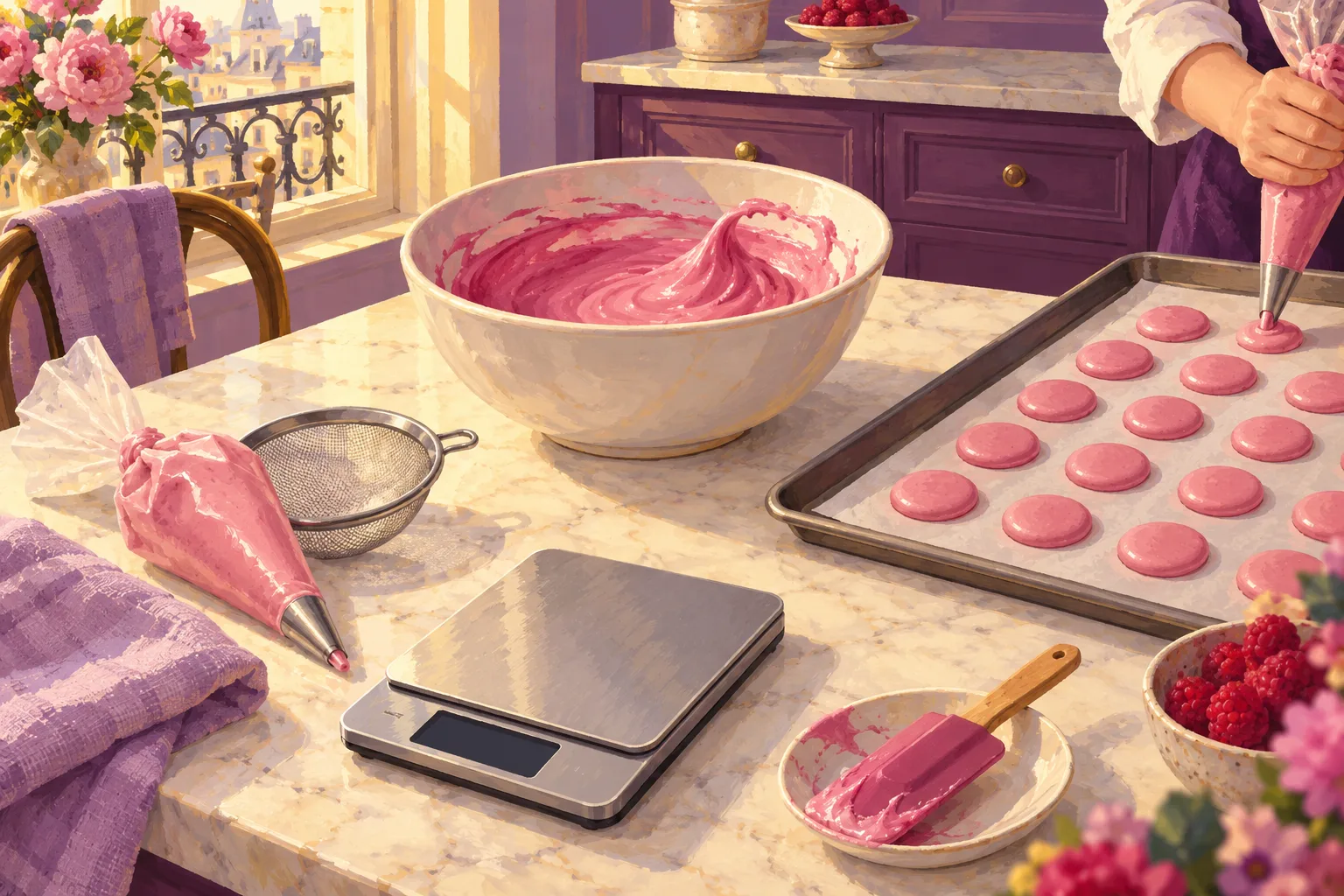
In the school’s technique recipe, a tamis is a sieve, a spatule folds the mixture, and a poche à douille is a piping bag fitted with a nozzle. The shells go onto a plaque de cuisson, a baking tray. Keep these names close to the object in front of you; the chef may hand you a different size of nozzle or tool.
Macaronage is the folding stage that changes the mixture’s texture. Le Cordon Bleu’s chefs describe the goal as lisse et brillante — smooth and glossy. Ask Est-ce que la pâte est assez lisse ? and show the bowl. If the chef says Pas encore. (“Not yet”), watch another movement before you continue. Pouvez-vous me montrer le geste encore une fois ? asks for that demonstration, rather than another verbal description.
Check the oven instruction before moving the tray
On enfourne maintenant ? asks whether it’s time to put the shells in the oven. You may hear Pas encore, laissez croûter les coques. — “Not yet; let the shells form a skin.” The school’s public recipe says to wait until the shells no longer stick to a finger before baking. Follow the chef’s check for the batch you made.
Ask À quelle température ? Et pour combien de temps ? — “At what temperature? And for how long?” The public recipe gives 140 °C (285 °F) for about 12 minutes, but a class may use another method, filling or oven. Don’t set the oven from an unrelated recipe. Let the chef confirm the temperature and timing, and ask before handling a hot tray.
Hear both sides of a short exchange
This is a practice exchange built from the school’s published technique, not a report of what a Paris chef said to a student.
- Chef: Tamisez la poudre d’amandes avec le sucre glace. — Sift the ground almonds with the icing sugar.
- You: Pardon, c’est bien le tamis ? — Sorry, is this the sieve?
- Chef: Oui. Ensuite, mélangez avec la spatule. — Yes. Then mix with the spatula.
- You: Pouvez-vous me montrer le geste encore une fois ? — Could you show me the movement again?
- Chef: Bien sûr. Regardez la texture : elle doit être lisse et brillante. — Of course. Look at the texture: it should be smooth and glossy.
- You: On enfourne maintenant ? — Do we put it in the oven now?
- Chef: Pas encore. Attendez que les coques ne collent plus. — Not yet. Wait until the shells no longer stick.
When a direction runs past you
Say Pardon, pouvez-vous répéter plus lentement ? France Éducation international recommends asking for a repeat or slower speech when you miss a direction. If a number still isn’t clear, point to the line on the recipe and ask the chef or interpreter to confirm it before weighing, piping or heating anything.
For a spelling cue, the final -ez of tamisez sounds like “ay”; the final -s of grammes stays silent. These aren’t a substitute for hearing Paris French. A Paris French speaker hasn’t checked the full practice exchange, and there’s no inline audio because a French (France) voice and its playback haven’t been checked by ear. Practise the slower-repeat request and the oven question before class. For ordering the finished pastries at a counter, see the French bakery phrase guide.