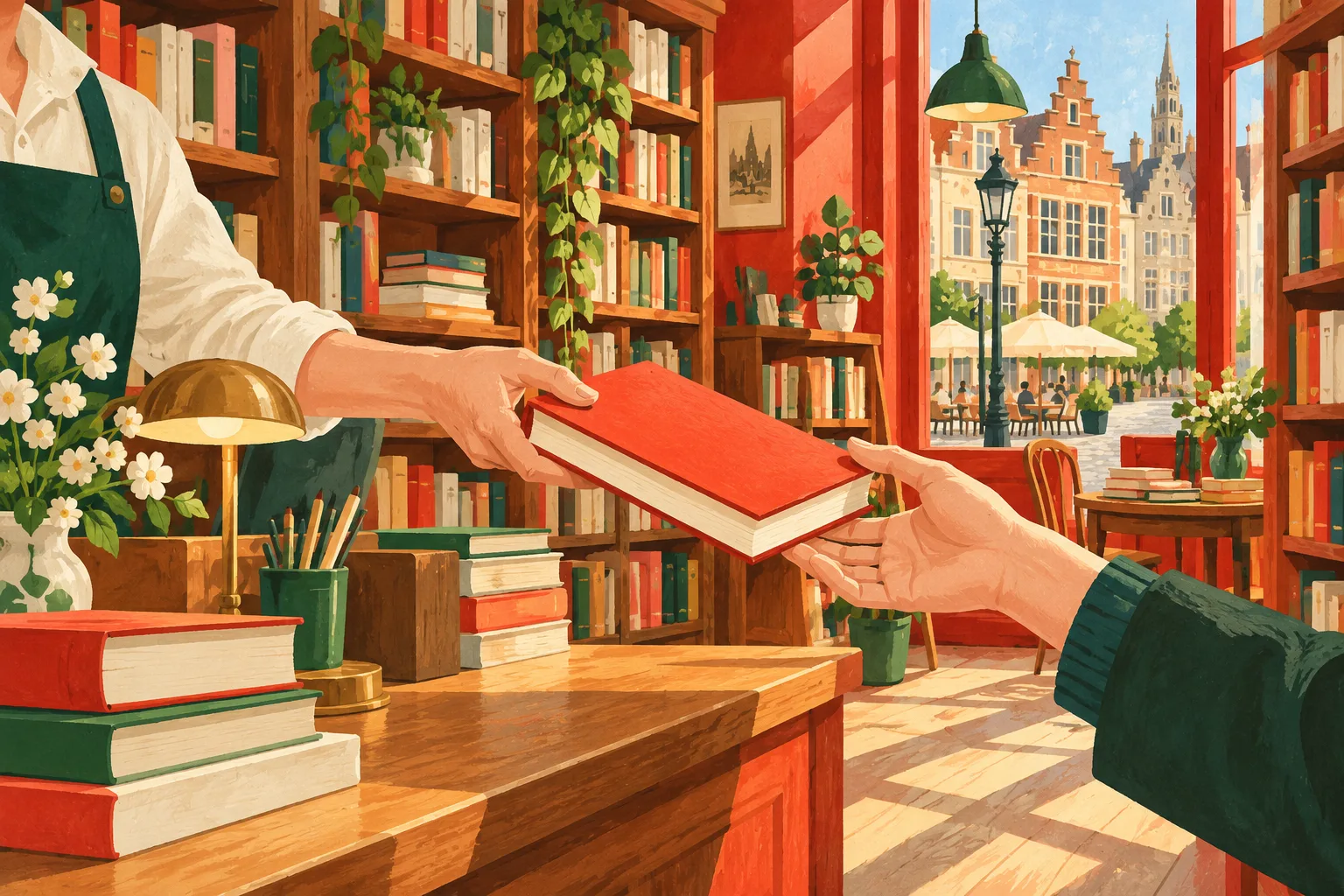
French in a Brussels Bookshop: Asking for a Local Recommendation
In a Brussels bookshop, ask for the kind of book you enjoy, then ask the bookseller for a writer from the city. Before you buy, check the language of the edition and its price. A title on a multilingual shelf may have editions in more than one language.
This practice scene takes place at Passa Porta Bookshop, which describes its shelves as multilingual and lists novels among its books. The dialogue below is an example, not a conversation with its staff or a claim that a particular title is in stock. Check the shop’s current details before visiting.
Six lines to take into the shop
Start with bonjour and use vous with someone you’ve just met. You can point to a book as you ask about its edition and price.
| Say this | Meaning |
|---|---|
| Bonjour. Je cherche un roman policier. | Hello. I’m looking for a crime novel. |
| Vous me conseillez un auteur ou une autrice de Bruxelles ? | Can you recommend a writer from Brussels? |
| Vous avez quelque chose de court ? | Do you have something short? |
| Vous avez une édition en français ? | Do you have a French-language edition? |
| Combien coûte ce livre ? | How much does this book cost? |
| Pardon, vous pouvez répéter plus lentement ? | Sorry, can you repeat that more slowly? |
Ask for a local writer, then narrow the choice
The request Vous me conseillez un auteur ou une autrice de Bruxelles ? asks for the bookseller’s judgement. Add a genre you actually read: Je cherche un roman policier. means you’re looking for a crime novel. If length matters, ask Vous avez quelque chose de court ? You may hear Vous cherchez quel genre ? — “What genre are you looking for?” — before the bookseller suggests a title.
Passa Porta’s October 2026 programme included Thomas Gunzig and his novel Spectres; the bookshop describes him as born in Brussels. That gives you one name to bring up if you want a starting point. Ask what the bookseller recommends today rather than assuming that book or another local title is on the shelf.
Check the edition and the price
Once the bookseller shows you a book, check the language of the copy in your hands. Vous avez une édition en français ? asks for a French-language edition. If you want to know whether a book is a translation, ask C’est une traduction ? — “Is it a translation?” Look at the title and publisher page as well; a familiar title doesn’t tell you which language this copy uses.
Point to the copy and ask Combien coûte ce livre ? You may hear Le prix est indiqué au dos. — “The price is shown on the back.” If the number isn’t clear, ask Vous pouvez me montrer le prix ? — “Can you show me the price?” This avoids guessing at a spoken number.
A short exchange at the counter
This exchange is for practice. The bookseller’s replies are possible answers, not a script from Passa Porta.
- You: Bonjour. Je cherche un roman policier. Vous me conseillez un auteur ou une autrice de Bruxelles ? — Hello. I’m looking for a crime novel. Can you recommend a Brussels writer?
- Bookseller: Vous cherchez quelque chose de court ? — Are you looking for something short?
- You: Oui, si possible. Vous avez une édition en français ? — Yes, if possible. Do you have a French-language edition?
- Bookseller: Oui, celle-ci est en français. — Yes, this one is in French.
- You: Combien coûte ce livre ? — How much does this book cost?
- Bookseller: Le prix est indiqué au dos. — The price is shown on the back.
- You: Merci. Je peux le feuilleter ? — Thanks. May I leaf through it?
Here celle-ci means “this one” and points to the edition the bookseller holds. Le in the last line refers to the book. If you don’t want to buy it, Merci, je vais réfléchir. — “Thanks, I’ll think about it.” — closes the conversation politely.
Follow the bookseller’s language
Brussels has French and Dutch as its official languages. A multilingual bookshop can also carry books in English, but that doesn’t tell you which language the person at the counter prefers. Begin with the language you can use, listen to their reply, and follow their lead when you share another language.
If they answer in Dutch and you speak Dutch, switch to it. If you don’t, you can ask Vous préférez qu’on parle anglais ? — “Would you prefer that we speak English?” — and wait for the answer. If English isn’t shared, show the title or write your genre and the edition language you want. For another Brussels first-contact scene, see the Brussels café guide.
If you miss the reply
Say Pardon, vous pouvez répéter plus lentement ? If the title or writer’s name still escapes you, ask Vous pouvez l’écrire, s’il vous plaît ? — “Could you write it down, please?” You can then check the spelling on the cover before you leave.
For a rough pronunciation cue, the ou in vous sounds like “oo” in “food,” and the ç in français sounds like “s.” The final s in vous is silent. These cues aren’t a recording of Brussels French. A fluent Brussels French speaker hasn’t reviewed this full exchange yet, and there’s no inline audio because a Belgian French voice and its playback haven’t been checked by ear. Practise the genre, edition and slower-repeat questions before you go. For more first-contact lines, see the French survival phrases guide.