Spanish and Quechua in Peru: What a Traveller Should Understand
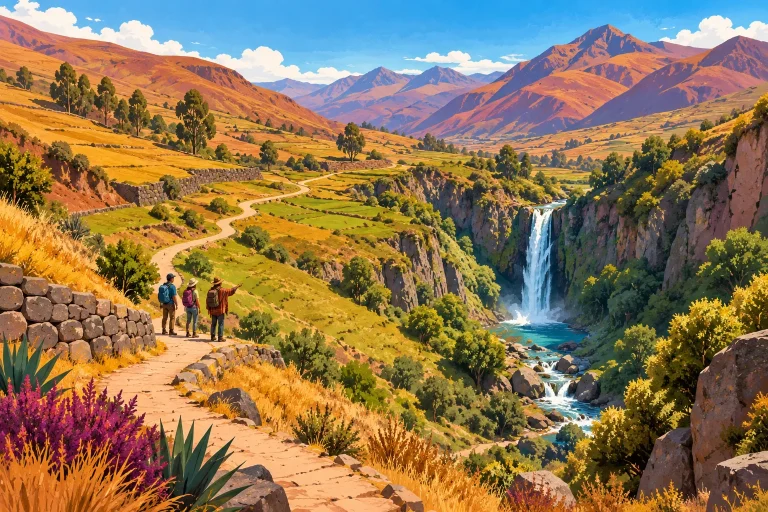
A map of the Cusco area gives you two names for the same waterfall: Poq Poq and Poc Poc. Spanish helps you ask which name your guide uses and where the path goes. It doesn’t explain every name you’ll see. Quechua has a long history in this region, and people still speak it today.
If you’re travelling with a Spanish-speaking guide, start with the name in front of you. Ask how people say it locally, listen to the answer, and use that answer for the rest of the conversation. You don’t need to guess a Quechua pronunciation from a map.
Five Spanish questions to keep at hand
- Disculpe, ¿este nombre está en quechua? — Excuse me, is this name in Quechua?
- ¿Cómo se pronuncia aquí? — How do people pronounce it here?
- ¿Cómo se escribe en este mapa? — How is it written on this map?
- ¿Poq Poq y Poc Poc son el mismo lugar? — Are Poq Poq and Poc Poc the same place?
- ¿Puede repetirlo más despacio, por favor? — Could you say it again more slowly, please?
These are questions in Spanish. They don’t require the other person to speak Quechua or to explain a name’s origin. If you ask about a name, leave room for “I don’t know” as an answer.
Why you may see Spanish and Quechua together
Peru’s Ministry of Culture describes Quechua as a family of regional varieties. Its account places Quechua Collao in Cusco and lists other varieties in other parts of Peru. Calling a Cusco name “Quechua” can be a starting point, but it doesn’t tell you which variety a person speaks or how they say that name.
Spanish is the language a visitor will often use to arrange a route, ask a price, or speak with a guide. A place name can come from Quechua even when the rest of the conversation is in Spanish. The ministry lists 48 Indigenous languages in Peru, so a Spanish-and-Quechua description doesn’t cover the whole country.
The Cusco Ministry of Culture office calls its Andean road project Qhapaq Ñan and explains the name in its account of the route. That official usage shows why you may encounter a Quechua name in Spanish-language visitor information. It doesn’t mean that every road near Cusco belongs to that route.
A real name, two official spellings
Peru’s tourism inventory calls the Chinchero waterfall Catarata Poq Poq. A Peruvian ecotourism guide writes Catarata Poc Poc. Both point to the waterfall near Chinchero. If your map and your guide use different spellings, show the map and ask about the destination. Don’t use the spelling alone to decide that there are two waterfalls.
Our Spanish guide to a hike near Chinchero covers route, meeting-point, and weather questions for a guided walk to Poq Poq. Here, the question is how to handle a name when your sources don’t match.
A short exchange with a guide
This is a practice exchange about the two published spellings. It isn’t a transcript of a conversation in Chinchero.
- Traveller: En esta ficha dice Poq Poq y en esta guía dice Poc Poc. ¿Es la misma catarata?
On this listing it says Poq Poq, and in this guide it says Poc Poc. Is it the same waterfall? - Guide: Sí, las dos se refieren a la catarata cerca de Chinchero.
Yes, both refer to the waterfall near Chinchero. - Traveller: Gracias. ¿Cómo se pronuncia el nombre aquí?
Thanks. How do people pronounce the name here? - Guide: No estoy seguro. Podemos preguntarle a alguien de la zona.
I’m not sure. We can ask someone from the area. - Traveller: De acuerdo. ¿Puede mostrarme el camino en el mapa?
All right. Can you show me the route on the map?
The guide doesn’t have to supply a pronunciation they don’t know. The traveller can still settle the immediate route question. If someone from the area offers a pronunciation, listen and follow their lead; don’t turn it into a request for an impromptu language lesson.
When a sign or map gives you too little context
Read the destination and the route together. A name on a sign may look different from the name in a booking message or a travel guide. Ask ¿Es este el camino a la catarata? (“Is this the path to the waterfall?”) while pointing to the map or sign. If the answer is fast, use ¿Puede repetirlo más despacio, por favor?.
If you want to know what language appears on a sign, ask rather than infer it from unfamiliar letters. ¿Este letrero está en español o en quechua? means “Is this sign in Spanish or Quechua?” Some signs contain more than a place name; others have only a name. Check what the sign actually says before assuming it has a full translation.
Keep the conversation respectful
A person’s language isn’t something you can infer from their clothing, job, or address. Ask a guide or host whether they know a name’s local usage; accept the answer they give. If you want a broader account of Quechua-speaking life in the Sacred Valley, read work produced by people there. The Kusi Kawsay Association in the Pisac area shares its own education and cultural work online. Its site is a place to learn from the organisation’s account, not an invitation to visit a school unannounced.
For the Spanish questions here, stress pronuncia on nun (pro-NUN-cia), escribe on cri (es-CRI-be), and despacio on pa (des-PA-cio). I’ve left out Quechua learner phrases because the variety and local pronunciation need speaker review. Use your guide’s answer for the name in front of you.