Belgian French and France French: What a Traveller Will Hear
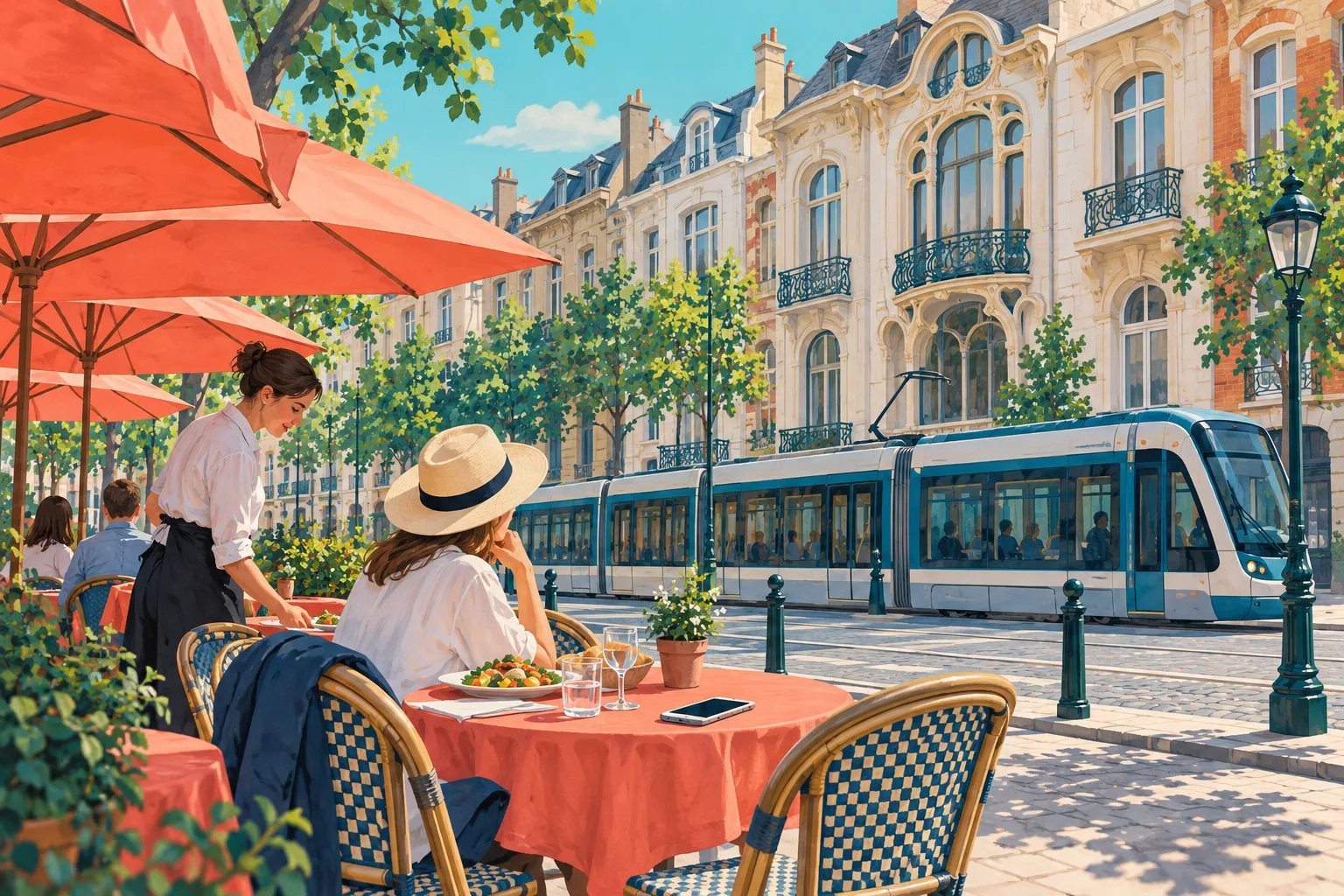
At a café in Brussels, a server may say septante euros for a group bill of €70. In Paris, you’re more likely to hear soixante-dix euros for the same amount. The number changes; the amount doesn’t. If the reply runs past you, repeat the number you heard and ask for confirmation.
This is a listening guide for a visitor moving between Brussels and Paris. It compares a few common words you can use in an actual exchange. It doesn’t assign every person in Belgium or France the same vocabulary or accent.
First, catch the number
The Académie française records septante and nonante as established forms in Belgium. Its account also notes that they’re known in parts of France. In Brussels, listen for these forms when someone gives a price, time or address number; in Paris, expect the more common France forms beside them.
| Amount | Brussels French | Paris French |
|---|---|---|
| 70 | septante | soixante-dix |
| 80 | quatre-vingts | quatre-vingts |
| 90 | nonante | quatre-vingt-dix |
Eighty stays quatre-vingts in this Belgian comparison. Don’t import Swiss huitante into a Brussels phrase card: the Académie separates that Swiss form from the usual Belgian one. Read the amount on a till or receipt if you need to settle a payment rather than relying on sound alone.
For pronunciation, Larousse gives septante as /sɛptɑ̃t/: you hear the p and the final t. Its entry for nonante gives /nɔnɑ̃t/, again with a final t. The vowel before that t is nasal in both. These written cues help you recognise the words; they don’t reproduce a particular speaker’s voice.
Then check which meal someone means
A regional French survey found that the sequence déjeuner (morning), dîner (midday) and souper (evening) dominates in Belgium. In much of France, the common sequence is petit déjeuner, déjeuner and dîner. Parts of France also use the first sequence, so the clock is more reliable than a country label.
If a Brussels host says On dîne à midi, they mean lunch at noon. A Paris host who says On dîne à vingt heures means an evening meal at 20:00. When arranging a table, ask C’est pour midi ou pour ce soir ? (“Is that for noon or this evening?”). It fixes the time without correcting anyone’s word.
At a restaurant, you can also ask Vous servez à midi ? or Vous servez ce soir ?. Those questions work without guessing the name the person uses for the meal. Check the venue’s current hours before you set out.
A small object with a different name
If someone says you left your GSM behind in Brussels, they mean your mobile phone. A regional vocabulary survey finds GSM common in Belgium and portable common in France. Belgian public-service writing also uses GSM. If you need a word that stays clear in either place, say mon téléphone and point to it.
The contrast is about what you may hear. Someone in Belgium may understand portable, and someone in France may understand GSM; there’s no need to swap every word you know before you cross a border.
A short exchange at a Brussels café
This is a practice exchange about a group bill. It isn’t a transcript from a real café, and €70 is an example amount rather than a current menu price.
- Server: Ça fait septante euros pour la table.
That’s €70 for the table. - You: Pardon, vous avez dit septante euros ?
Sorry, did you say €70? - Server: Oui, septante euros.
Yes, €70. - You: Merci. Je peux payer par carte ?
Thanks. Can I pay by card? - Server: Oui, bien sûr.
Yes, of course.
If a number still isn’t clear, ask Pouvez-vous l’écrire, s’il vous plaît ? (“Could you write it down, please?”). For a bill, the printed amount or payment terminal gives you another check. In the site’s Brussels bookshop guide, you can practise checking the language of an edition and its price in a different setting.
Listen to the person, not a national label
UCLouvain’s research on French pronunciation in Belgium examines variation between speakers and places. There isn’t one accent to copy for every Belgian French speaker. The number words above give you a focused listening target; they don’t explain every vowel or rhythm you’ll hear.
Brussels is also officially bilingual in French and Dutch. French helps in many Brussels encounters, but it doesn’t describe every person or every sign. Start with a greeting, notice the reply, and ask which language works for the conversation if you’re unsure.
Before a trip, practise hearing septante and nonante beside soixante-dix and quatre-vingt-dix. For a meal plan, confirm the hour. The full dialogue and local pronunciation still need a Brussels French speaker’s review, so this article has no inline audio.