Mandarin for a Sichuan Cooking Class in Chengdu
In a Chengdu cooking class, ask what goes into the pan before you pick up a knife or change the heat. These Mandarin lines help you identify a spice, check the size of a cut, and ask the teacher when to stop cooking. They use standard mainland Mandarin in simplified characters with tone-marked pinyin, not a claim about how every Chengdu instructor speaks.
The Sichuan Cuisine Museum’s interactive hall says visitors can make several classic dishes under an instructor’s guidance and work through knife skills, heat and the finished dish. Its page doesn’t name a fixed menu or teaching language. Ask which dish you’ll make and whether your session uses Mandarin before booking. The exchange below is practice, not a transcript of the museum’s staff.
Six lines for the cooking bench
Point to the ingredient or pan as you ask. Qǐngwèn opens a polite question to an instructor you haven’t met.
| Mandarin and pinyin | Meaning |
|---|---|
| 请问,今天做什么菜? Qǐngwèn, jīntiān zuò shénme cài? | Excuse me, what dish are we making today? |
| 这个是辣椒还是花椒? Zhège shì làjiāo háishi huājiāo? | Is this chilli or Sichuan pepper? |
| 豆腐要切多大? Dòufu yào qiē duō dà? | How large should I cut the tofu? |
| 可以再示范一次吗? Kěyǐ zài shìfàn yí cì ma? | Could you show me once more? |
| 现在用大火还是小火? Xiànzài yòng dàhuǒ háishi xiǎohuǒ? | High heat or low heat now? |
| 这个要煮多久? Zhège yào zhǔ duōjiǔ? | How long should this cook? |
Identify the spice before it goes in
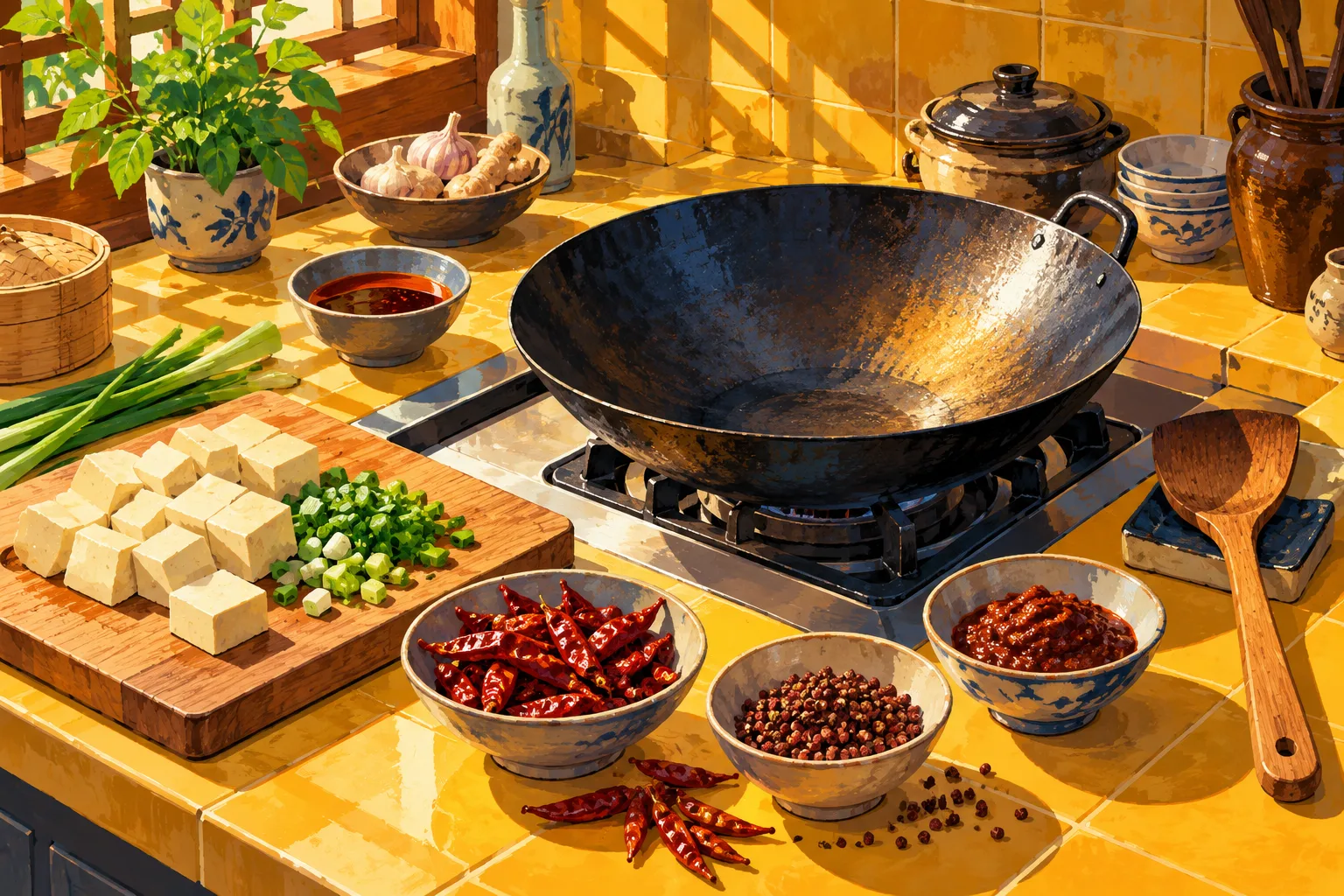
辣椒 làjiāo is chilli; 花椒 huājiāo is Sichuan pepper. They do different things to a dish, so point to the bowl and ask 这个是辣椒还是花椒? The State Administration for Market Regulation lists chilli, Sichuan pepper and bean paste among ingredients used in spicy hot-pot bases; that source doesn’t tell you what today’s class has set out. Ask the teacher about the actual bowls.
If you want less chilli, say 可以少放一点辣椒吗? Kěyǐ shǎo fàng yìdiǎn làjiāo ma? — “Could we add a little less chilli?” A teacher may be making a set recipe for the group, so listen to their answer before changing an ingredient. A serious allergy needs a checked written translation and direct confirmation of ingredients and shared equipment; a short phrase can’t settle it.
Check the cut before using the knife
豆腐要切多大? asks about the size of tofu pieces. You may hear 切成小块。 Qiē chéng xiǎo kuài. — “Cut it into small pieces.” Small is relative to the dish. Ask 可以再示范一次吗? and watch the teacher cut one piece before you start.
The tofu is an example, not the museum’s daily menu. A current Chengdu tour provider lists mapo tofu or kung pao chicken as possible museum-class dishes, subject to availability on site. The museum teaches particular dishes in a session; one class doesn’t cover all Sichuan cooking.
Ask about the heat and timing
大火 dàhuǒ means high heat and 小火 xiǎohuǒ means low heat. Ask 现在用大火还是小火? before touching the burner. If the teacher says 先别下锅。 Xiān bié xiàguō. — “Don’t put it in the pan yet” — wait for the demonstration.
煮 zhǔ refers to cooking in liquid; 炒 chǎo refers to stir-frying. For a simmering pan, ask 这个要煮多久? For a stir-fry, replace zhǔ with chǎo: 这个要炒多久? Zhège yào chǎo duōjiǔ? Watch what the teacher is doing; don’t turn a sample line into a fixed cooking time.
If the dish contains meat, keep raw and cooked tools separate and ask the instructor to check it before tasting. China’s market regulator advises separate tools for raw and cooked meat and thorough cooking. The written term 生熟分开 shēng shú fēnkāi means “keep raw and cooked separate.” A traveller’s phrase card doesn’t establish when a particular piece is safe to eat.
A short exchange with the instructor
This imagined class makes mapo tofu so you can follow one coherent sequence. The museum hasn’t promised that dish for your visit.
- You: 请问,今天做什么菜? Qǐngwèn, jīntiān zuò shénme cài? — What dish are we making?
- Instructor: 今天做麻婆豆腐。 Jīntiān zuò mápó dòufu. — Today we’re making mapo tofu.
- You: 这个是辣椒还是花椒? Zhège shì làjiāo háishi huājiāo? — Is this chilli or Sichuan pepper?
- Instructor: 这是花椒。 Zhè shì huājiāo. — It’s Sichuan pepper.
- You: 豆腐要切多大? Dòufu yào qiē duō dà? — How large should I cut the tofu?
- Instructor: 切成小块。我来示范。 Qiē chéng xiǎo kuài. Wǒ lái shìfàn. — Cut small pieces. I’ll show you.
- You: 现在可以下锅吗? Xiànzài kěyǐ xiàguō ma? — Can I put it in the pan now?
- Instructor: 等一下,先别下锅。 Děng yíxià, xiān bié xiàguō. — Wait; don’t add it yet.
- You: 好。现在用大火还是小火? Hǎo. Xiànzài yòng dàhuǒ háishi xiǎohuǒ? — Okay. High or low heat now?
- Instructor: 先用小火。 Xiān yòng xiǎohuǒ. — Start with low heat.
When the reply runs past you
Say 不好意思,可以说慢一点吗? Bù hǎoyìsi, kěyǐ shuō màn yìdiǎn ma? — “Sorry, could you speak a little more slowly?” Point to the cutting board or stove and ask for another demonstration if the action still isn’t clear. Set the knife down or leave the heat alone while you check.
The tone marks in làjiāo and huājiāo show different opening syllables; they aren’t English stress marks. These lines are standard Mandarin practice. A Chengdu-based college describes differences between Sichuan local speech and Putonghua, so don’t treat the pinyin as a recording of a Chengdu accent. A Chengdu Mandarin speaker hasn’t reviewed this full exchange, and there’s no inline audio because a suitable voice and its playback haven’t been checked by ear.
Before class, practise the spice question, the request to see a cut again, and the heat question. Check the day’s dish and teaching language when you book. For the different task of ordering food that others cook at a shared table, see the Chongqing hot pot Mandarin guide.